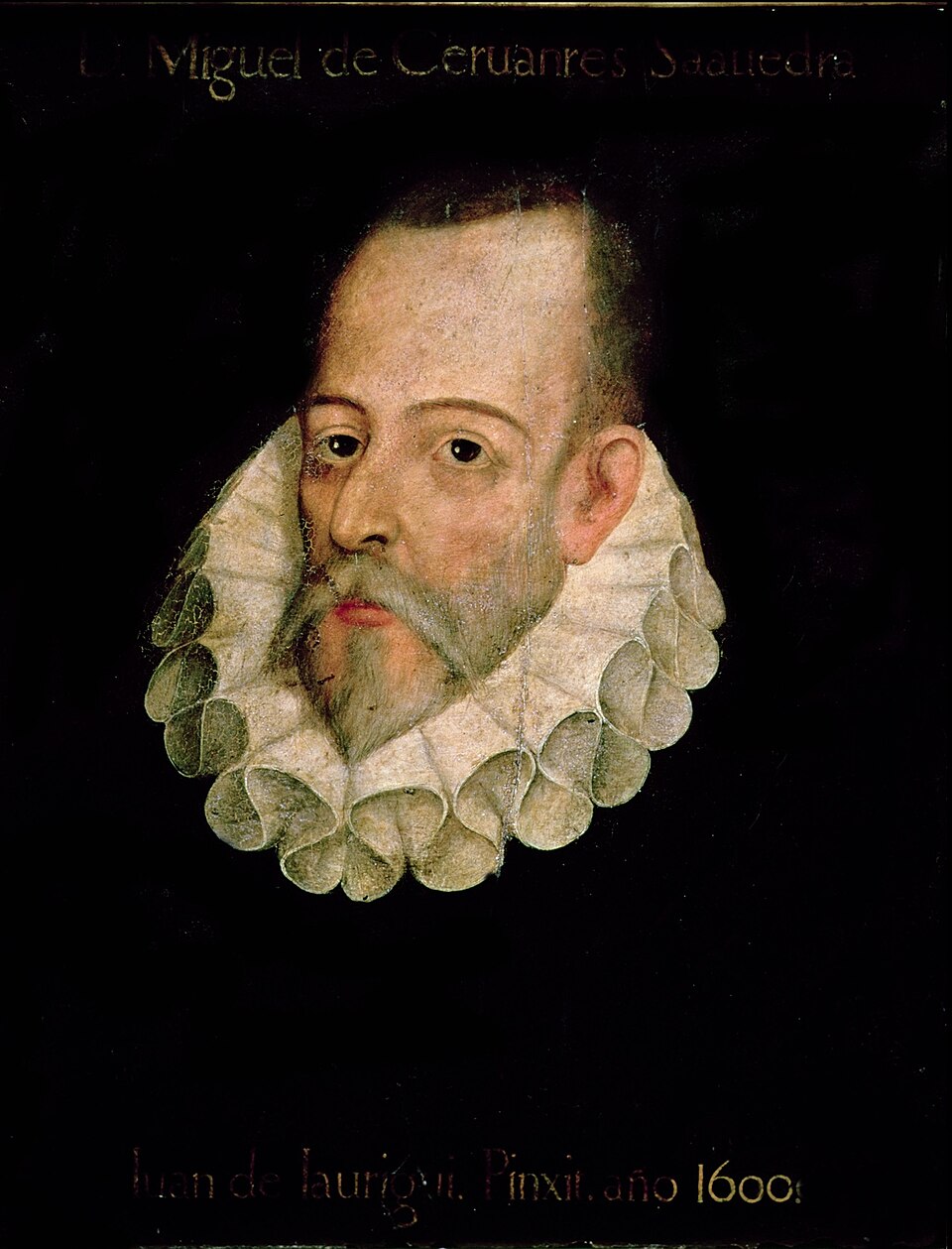
Writing · 1547–1616
Miguel de Cervantes
El dato sorprendente
His hero jokes that his hand was maimed in the greatest battle of the age. The joke was autobiography: Cervantes really did lose the use of his left hand at Lepanto, and was proud of it for the rest of his life.
Miguel de Cervantes was born in 1547 in Alcalá de Henares, near Madrid, the fourth of seven children of a barber-surgeon who was chronically short of money and moved the family from town to town. Little is recorded of his schooling, though he read enough to fall for the Italian poets, and at twenty-two he turned up in Rome in the household of a Spanish cardinal. He left Spain in a hurry, probably to get out of the reach of the law after a street fight, which is why the road to his greatest book begins with a warrant and a cancelled apprenticeship.
In 1570 he enlisted as a soldier, and in October 1571 he was in the fleet at Lepanto, the great naval battle in which a Christian alliance broke the Ottoman navy in the Gulf of Patras. He had a fever that day and was told to stay below; he came up on deck anyway, fought in the front line, and took two shots in the chest and one in the left hand, which was left useless. He called it the noblest cause for which a soldier could be disabled, and he never stopped saying so. He served on at sea and in North Africa for another four years before sailing home in 1575.
The ship home was taken by Barbary corsairs off the Catalan coast, and Cervantes spent the next five years as a slave in Algiers. Letters of recommendation found on him made his captors think he was worth a fortune, so the ransom stayed high and the wait stretched on. He tried to escape four times, leading his fellow captives each time, and each time was caught; and each time, when the others were sentenced to be impaled or sent to the galleys, he took all the blame and somehow talked the pasha around. In 1580 Trinitarian friars finally bought him out.
What followed was twenty lean years: an army pay office he could never quite get settled, a marriage that did not take, plays that did not succeed, a spell in jail in Seville over accounts he was sure balanced. Somewhere in that stretch, by his own account possibly in prison, he began a book about a thin old gentleman who reads too many chivalric romances and rides out to repair the world. The first part of Don Quixote appeared in 1605, when he was fifty-seven, and was an immediate success across Spain; the second, written in part to beat a pirated sequel by a rival, followed in 1615.
He died in Madrid in April 1616, a few days after finishing the last book he would ever publish, and was buried the next day in the habit of a Franciscan third order, as he had asked. In the same week Shakespeare died in England, though the calendars did not quite agree, and the two greatest writers of the age never knew of each other. Don Quixote has since been translated into more than 140 languages, and the picture of a dreaming man and a level-headed servant setting out together remains the shape of the modern novel.
Fuentes: Encyclopædia Britannica; Instituto Cervantes.
El cuestionario
Don Quixote’s creator has his hero joke about being maimed in the greatest naval battle of the age. What is the joke based on?
Hasta mañana. Tres caras nuevas llegan cada mañana.
Sin registro, sin pago. Las caras son gratis para leer. El correo de la mañana llega con el producto completo.