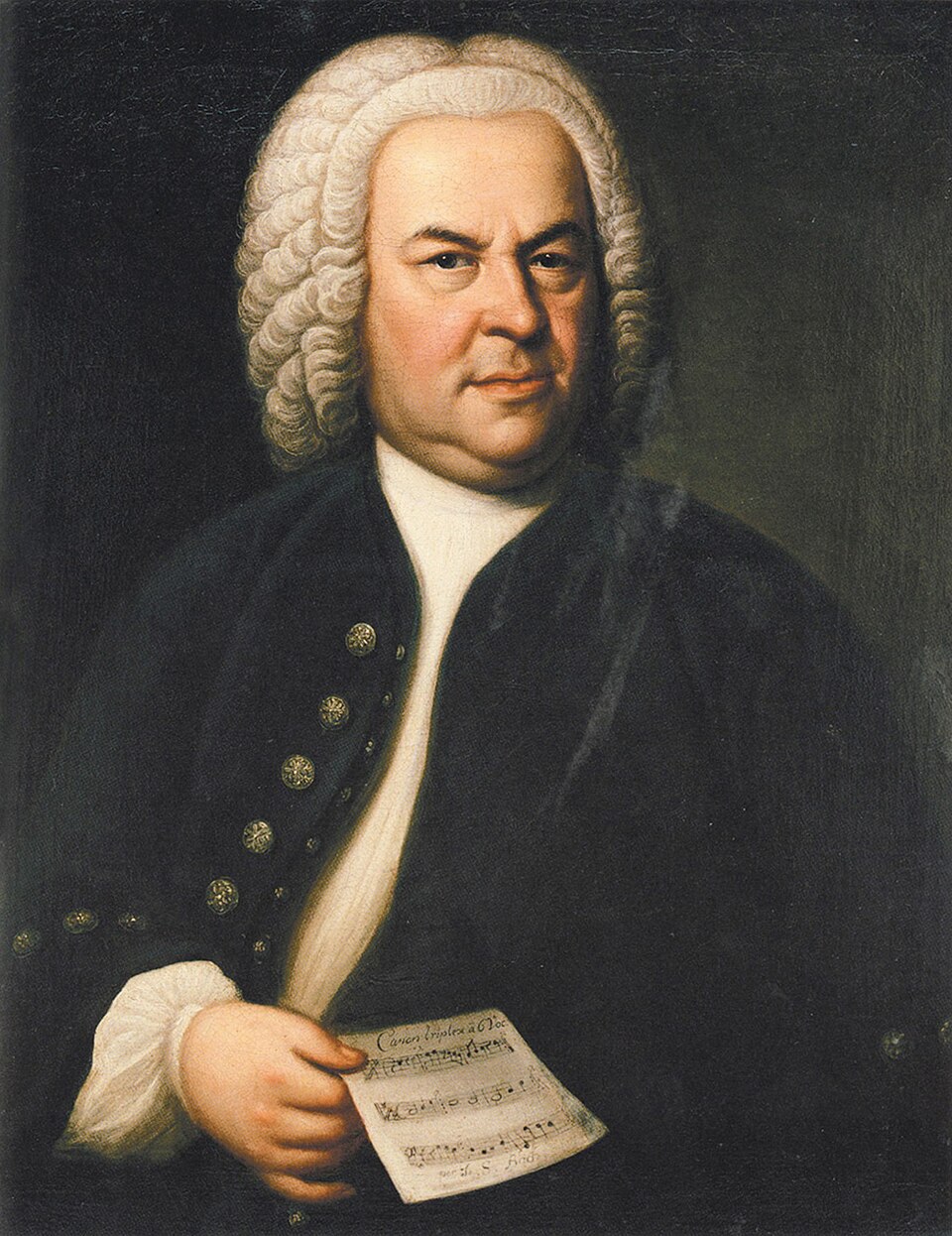
Music · 1685–1750
Johann Sebastian Bach
El dato sorprendente
When he died, his own music was already going out of fashion, and lay forgotten for decades. It took a twenty-year-old conductor, Mendelssohn, to bring the St Matthew Passion back in 1829.
Johann Sebastian Bach was born in 1685 in Eisenach, in the wooded heart of Germany, into a family so full of musicians that in Thuringia the word Bach meant musician. Both parents died before he was ten, and he was sent to live with his eldest brother in Ohrdruf, who gave him keyboard lessons and, according to family legend, forbade him a book of organ music so hard to get that the boy copied it out by moonlight over six months. He learned fast anyway. By fifteen he was earning his keep as a chorister in Lüneburg, and he was walking thirty kilometres at a stretch just to hear famous organists play.
At eighteen he took his first job, organist at a new church in Arnstadt, and it went badly in an instructive way. In 1705 he asked for four weeks of leave and walked about 400 kilometres to Lübeck to hear the great organist Buxtehude, then stayed nearly four months. The consistory complained that his accompaniments were too long and strange, that he had let an unknown young woman into the choir gallery, and that he had returned long overdue. He answered with a stubbornness that never left him, left for Mühlhausen after barely a year, and kept writing organ music of a difficulty almost nobody else could play.
Then came two courts. In Weimar, as court organist, he wrote nearly all of his greatest organ works and learned the craft of the fugue. In Köthen, working for a prince who loved chamber music, he wrote the Brandenburg Concertos and the first book of the Well-Tempered Clavier, and he married twice: Maria Barbara, who died suddenly in 1720 while he was away with the prince, and then Anna Magdalena, a singer who copied out his manuscripts and bore him many of his children. Of twenty children, ten survived to adulthood, and two of the sons became more famous composers in their own time than their father was.
In 1723 he took the post he would keep for the last twenty-seven years: cantor at St Thomas in Leipzig, responsible for the music of four churches and the education of the choir school. It was the hardest job he ever had and the least free, endless services, endless feasts, endless arguments with the town council over pay and candles. For years he produced a fresh cantata almost every week. In 1727 came the St Matthew Passion, written for Good Friday, and in 1749, nearly blind and twice operated on unsuccessfully, he dictated a chorale prelude and left the great Mass in B minor unfinished.
He died in Leipzig in July 1750. Within a generation the new style had moved past him, his music was sung mostly by specialists and his manuscripts were being sold off, some said by weight. In 1829 the twenty-year-old Felix Mendelssohn conducted the St Matthew Passion in Berlin, its first performance since the composer’s death, and the romantic age claimed him. Today the cantata-a-week routine of a provincial church job looks like the high point of Western music, and conductors still open his scores expecting to find something no one has quite matched.
Fuentes: Encyclopædia Britannica; Bach-Archiv Leipzig.
El cuestionario
Bach wrote the St Matthew Passion for a Good Friday service in Leipzig. What happened to it after his death?
Hasta mañana. Tres caras nuevas llegan cada mañana.
Sin registro, sin pago. Las caras son gratis para leer. El correo de la mañana llega con el producto completo.