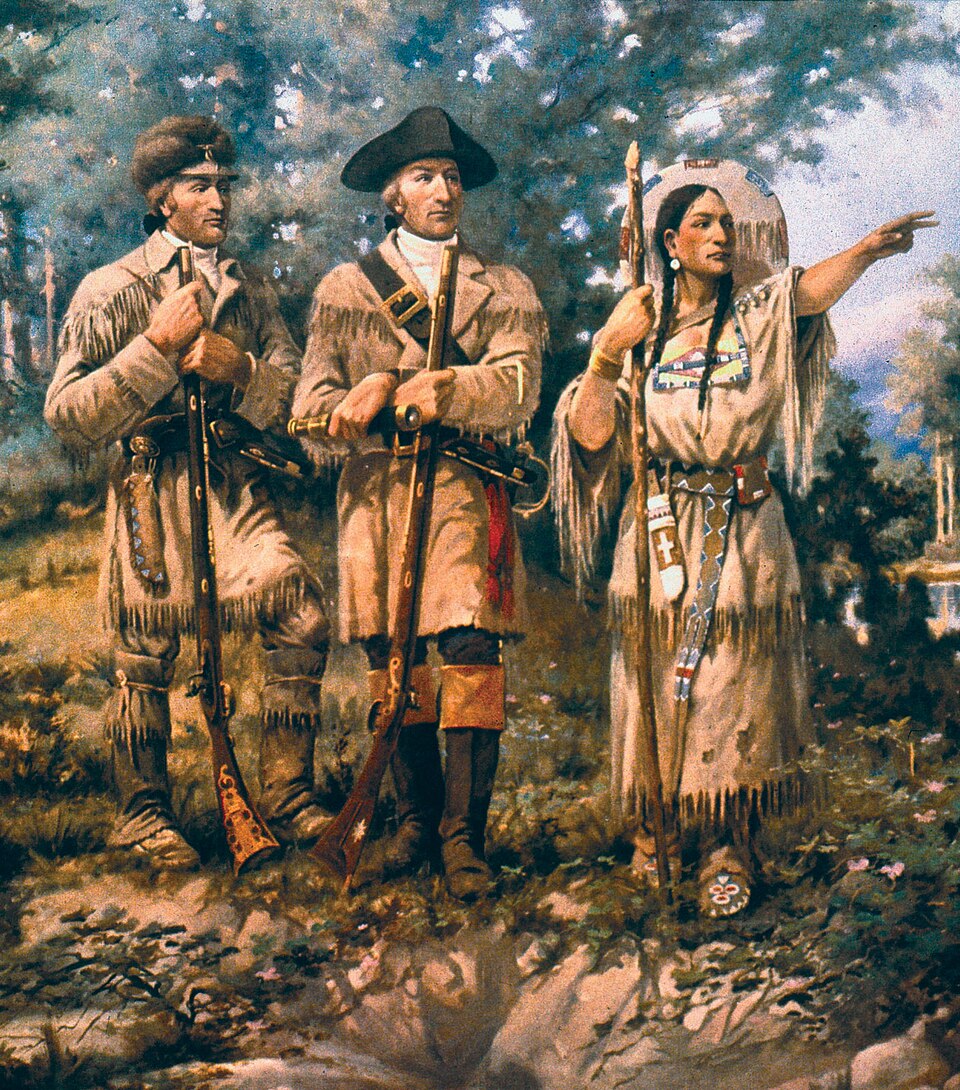
Exploration · c. 1788–1812
Sacagawea
Le fait surprenant
When the expedition finally reached the Shoshone and needed horses to cross the mountains, the chief who came out to trade turned out to be her own brother.
Sacagawea was born around 1788 in the Lemhi River valley of what is now Idaho, into a band of Shoshone people whose summers followed the salmon. When she was about twelve, a Hidatsa raiding party came down from the north, took her and other girls captive, and carried them back to villages near what is now Bismarck, North Dakota. There, still in her early teens, she was traded to a French-Canadian fur trader named Toussaint Charbonneau, who already had another Shoshone wife and had been living among the Hidatsa for years. Almost nothing about her first sixteen years is known beyond that outline, and much of it rests on the journals of men who met her later.
In the autumn of 1804 the Lewis and Clark expedition arrived and built Fort Mandan across the river for the winter. Lewis and Clark hired Charbonneau as an interpreter for the journey west, on the understanding that one of his Shoshone wives would come too, since they would need to buy horses from the Shoshone when they reached the mountains. Sacagawea was about sixteen and pregnant. Her son Jean Baptiste was born in the fort in February 1805, with Lewis attending the difficult delivery and, by his own account, dosing her with ground rattlesnake rattle to help her along. Two months later she set out up the Missouri with the infant on a cradleboard.
She pulled more than her weight and the journals say so. In May 1805, when a sudden squall nearly swamped one of the boats, it was Sacagawea, riding in it, who grabbed the overboard bundle and saved the papers, the medicines and the instruments while the men panicked. When game ran short she gathered edible roots and berries the men did not know. Clark named a river after her. And in August 1805, when the party finally met a Shoshone band and began to bargain for horses, the chief who came forward to talk was her own brother, Cameahwait, whom she had not seen in five years. The horses, and the guide who took them over the mountains, came out of that meeting.
The expedition returned her to the Mandan villages in August 1806. Charbonneau was paid just over five hundred dollars for his work; Sacagawea is not recorded as having received anything, though Clark wrote warmly in his journal of what she had done and later offered to bring up her son as his own. In 1809 the family travelled to St Louis, where Jean Baptiste was left with Clark for his schooling, and in 1811 Sacagawea gave birth to a daughter, Lisette. A trader’s journal records the death at Fort Manuel Lisa, on the upper Missouri, of Charbonneau’s wife of the Snake nation, in December 1812, probably of a fever. She was about twenty-four.
That record is where the documented life ends, and the arguments begin. Shoshone oral tradition holds that she survived the fever, left Charbonneau, and lived to old age on the Wind River Reservation, dying in 1884; the trader’s note may refer to another of Charbonneau’s wives. What is not in dispute is the legend: statues across the West, a mountain pass and a river named for her, her face on the dollar coin since 2000, and Clark’s own assessment, written in the journals, that without her the expedition could not have crossed the continent that year.
Sources: Encyclopædia Britannica; National Park Service.
Le quiz
Sacagawea guided Lewis and Clark west, and when the expedition reached the Shoshone to trade for horses, something happened that no one had planned. What was it?
À demain. Trois nouveaux visages arrivent chaque matin.
Sans inscription, sans paiement. Les visages sont gratuits à lire. L’e-mail du matin arrive avec le produit complet.