Abolition and reform · c. 1818–1895
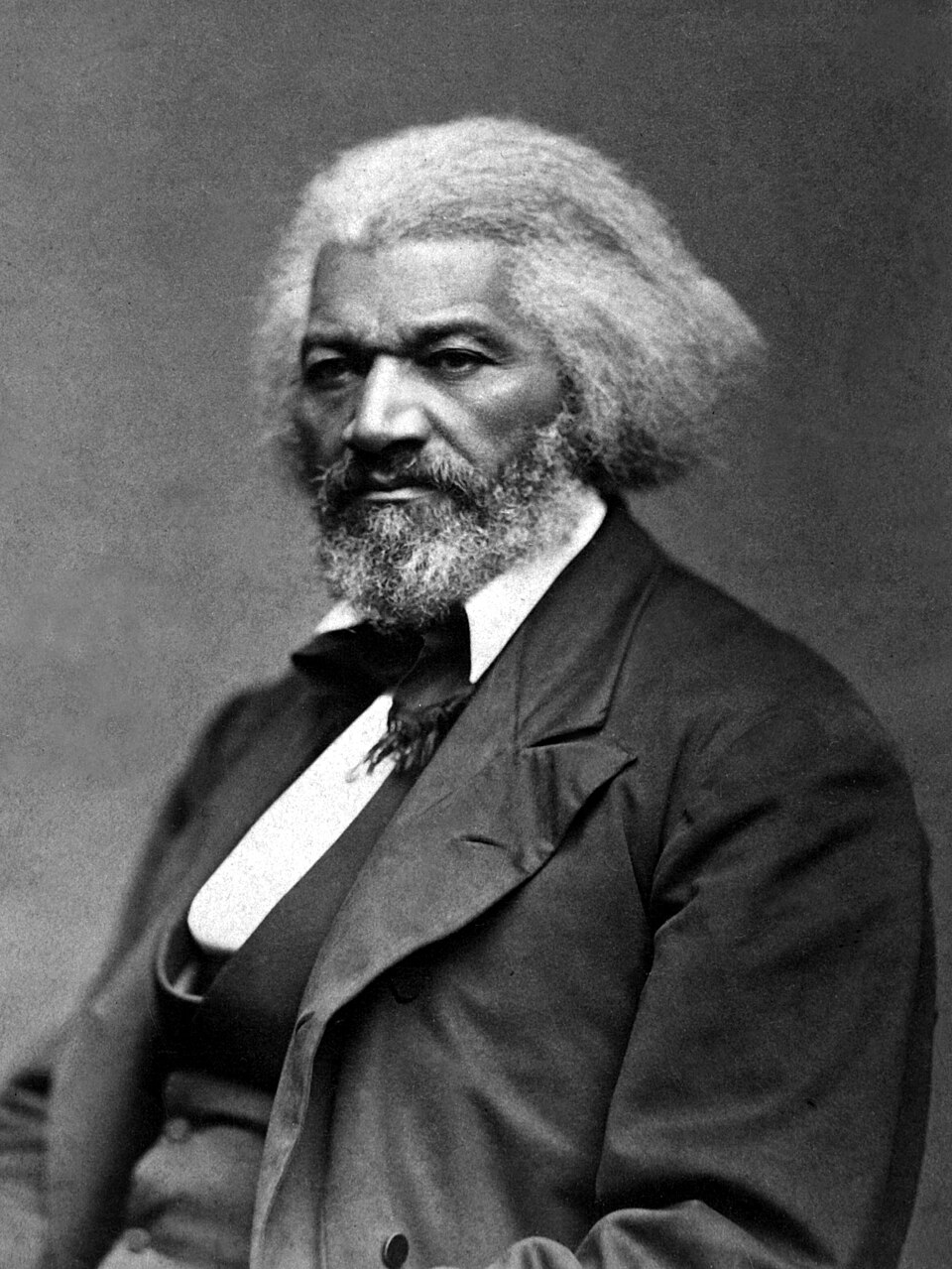
Frederick Douglass
Le fait surprenant
Nobody recorded the birthday of an enslaved child, so as a boy he picked February 14 for himself and kept it for the rest of his life.
Frederick Douglass was born enslaved around February 1818 on the eastern shore of Maryland, and never learned the exact day. His mother, Harriet Bailey, was hired out to a farm miles away and could visit only at night, walking there and back before dawn; she died when he was about seven. His father was a white man, almost certainly his mother’s owner, and was never a parent to him. The boy’s name was Frederick Bailey, and his earliest memories were of the whippings of the women around him, which he later said taught him more about the true nature of slavery than any argument ever did.
At about eight he was sent to Baltimore as a house servant, and there the wife of the family he served began teaching him the alphabet until her husband stopped her, saying that a literate slave was unfit for bondage. Douglass understood at once that the prohibition was the point. He carried a loaf of bread to the poor white boys in the streets of Baltimore and traded it for lessons, and he taught himself from a used book of famous speeches, reading them aloud to himself until he could give them. He wrote in later life that the more he read, the more he came to detest the people who had made him a slave without making him a man.
He was hired out to a farmer named Covey, a professional slave-breaker, and beaten so regularly that at sixteen he broke down. In 1834, after months of it, he fought back, and the two men wrestled in the yard for hours until Covey gave up; after that Covey never laid hands on him again. Douglass called that afternoon the turning point of his life. He tried once to escape and failed. In September 1838, aged twenty, he borrowed a free black sailor’s papers, boarded a train north under a pretence, and reached New York in a day and a half, where Anna Murray, a free woman who had helped him, married him twelve days later.
In New Bedford, Massachusetts, he took the name Douglass and worked as a labourer. In 1841, at an abolitionist meeting on Nantucket, he stood up to tell his own story and did it so well that he was hired on the spot as a lecturer. His book, Narrative of the Life of Frederick Douglass, appeared in 1845 and sold thousands of copies, and with his name and his owner’s now public he sailed for Britain and Ireland, where he spent nearly two years speaking against slavery. English supporters bought his freedom, and in 1847 he returned to Rochester, New York, to found his own newspaper, The North Star.
He argued with anyone, including allies: at Seneca Falls in 1848 he was one of the men who stood up for votes for women when others laughed. He recruited Black soldiers in the Civil War, two of his own sons among them, and pressed Lincoln at two meetings in the White House. After the war he held federal posts in Washington and served as consul to Haiti. In February 1895 he came home from a women’s rights meeting, described it to his wife, and died that evening, at about seventy-seven, in the house he had built on a hill outside the capital.
Sources: Encyclopædia Britannica; Library of Congress.
Le quiz
Frederick Douglass celebrated a birthday every year of his life. What is strange about the date he chose?
À demain. Trois nouveaux visages arrivent chaque matin.
Sans inscription, sans paiement. Les visages sont gratuits à lire. L’e-mail du matin arrive avec le produit complet.