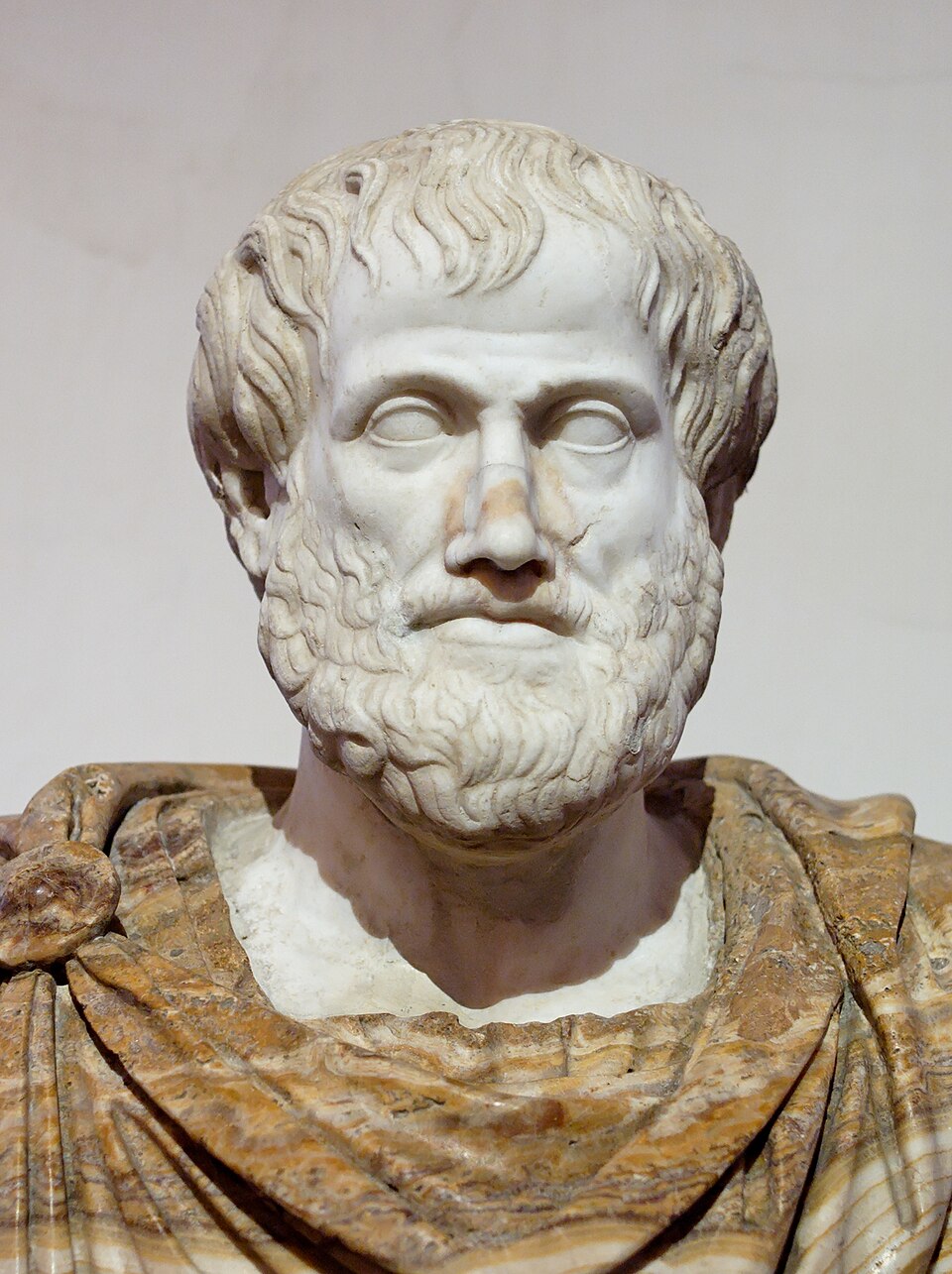
Philosophy · c. 384–322 BC
Aristotle
Le fait surprenant
The books that made him the most influential philosopher in history were never meant for publication. They are working lecture notes, stitched together from his own teaching.
Aristotle was born around 384 BC in Stagira, a small town on the coast of northern Greece. His father was physician to the king of Macedon, and the habit of looking at a living thing and asking what it was for stayed with him for life. Both parents died when he was young, and at about seventeen he was sent to Athens to the Academy of Plato, the most serious school in the Greek world. He stayed nearly twenty years, first as a student and then as a teacher, long enough for Plato to call him the mind of the school. When Plato died in 348 BC and leadership of the Academy went elsewhere, Aristotle left Athens.
The years that followed took him east and south. He taught at Assos on the coast of Asia Minor, married, and spent time on the island of Lesbos, where he studied the animals of a lagoon with a care that biologists still admire; his notebooks on fish, squid and embryos were not really superseded for two thousand years. In 343 BC Philip of Macedon summoned him to the capital to tutor his thirteen-year-old son Alexander, and for several years he taught the boy Homer, ethics and politics. Alexander later carried the Iliad on campaign in a precious casket, and whether that was Aristotle’s doing or simply a soldier’s taste, nobody can say.
In 335 BC he returned to Athens and opened his own school at the Lyceum, east of the city. It had covered walkways, and because he lectured while strolling under them his followers were called Peripatetics, the walkers. He taught advanced students in the morning and a broader public in the evening, kept one of the first great libraries, and collected descriptions of the constitutions of Greek cities. In that school he wrote, or dictated, the treatises that still carry his name: the logic, the Physics, the Ethics, the Politics, the Rhetoric and the Poetics, each one an entire field opened almost single-handedly.
In 323 BC Alexander died in Babylon, and anti-Macedonian feeling swept Athens. Aristotle had spent most of his life in the Macedonian orbit, and he now faced a charge of impiety, the same charge that had killed Socrates. Rather than stand trial he withdrew to Chalcis on the island of Euboea, his mother’s home, and is said to have remarked that he would not let Athens sin twice against philosophy. He died there the following year, in 322 BC, in his early sixties, of a stomach illness, after barely a year of exile.
The school carried on under his successor, and the treatises were eventually carried off to Alexandria and copied for centuries. What happened to them afterwards is the strange part: they passed through Roman confiscations, Arabic translations and Latin ones, and resurfaced in the Middle Ages as the base of European learning, so complete that people simply called him the Philosopher. And yet he never published a polished book. The great works are lecture notes, lists and drafts, most of them revised by students long after his death, while the elegant dialogues he actually wrote for the public have vanished entirely.
Sources: Encyclopædia Britannica; Stanford Encyclopedia of Philosophy.
Le quiz
Aristotle is credited with dozens of books that shaped Western thought for two thousand years. How much of that did he actually publish himself?
À demain. Trois nouveaux visages arrivent chaque matin.
Sans inscription, sans paiement. Les visages sont gratuits à lire. L’e-mail du matin arrive avec le produit complet.