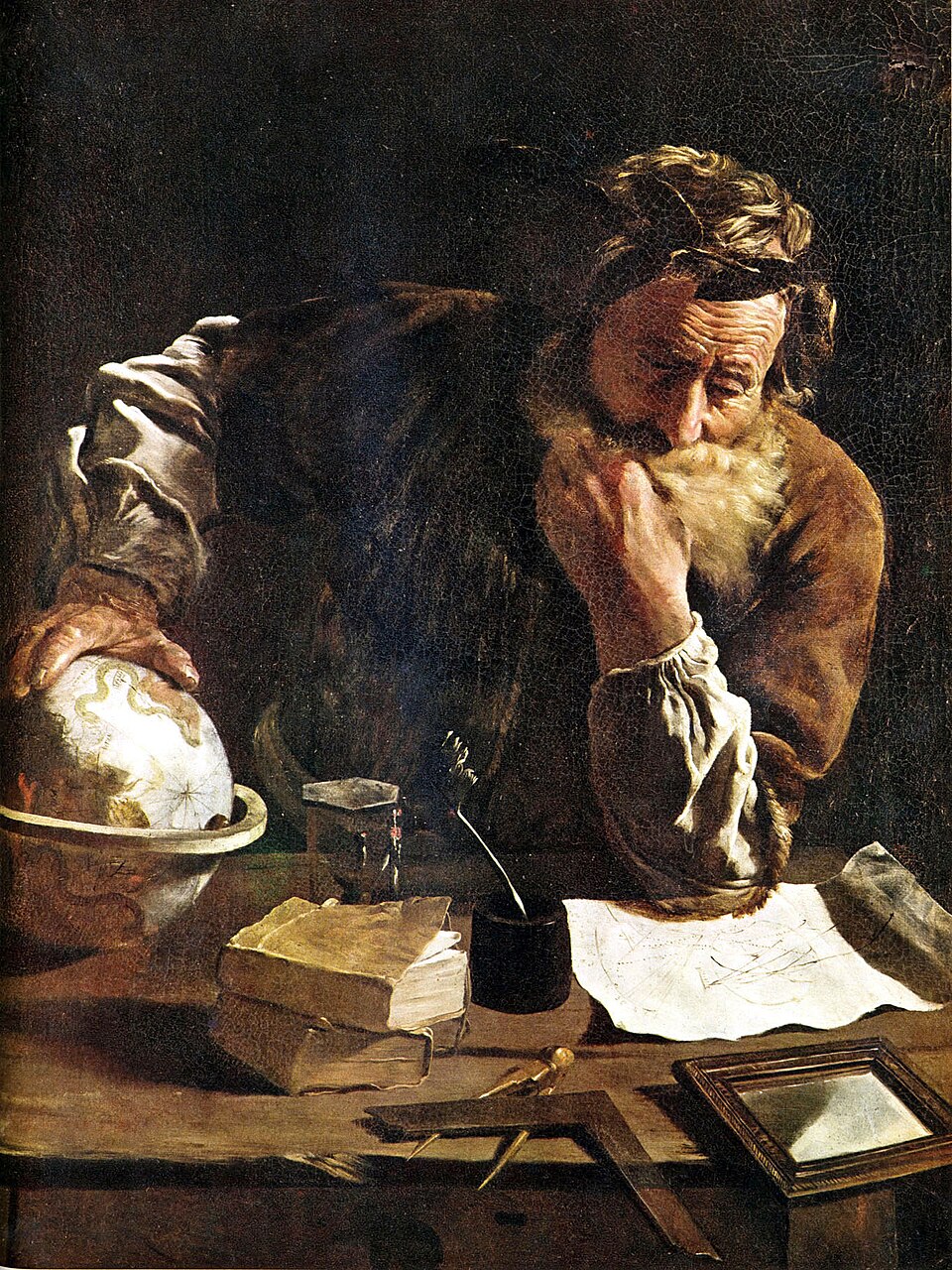
Mathematics · c. 287–212 BC
Archimedes
Le fait surprenant
The word Eureka comes from him: he is said to have run naked through Syracuse shouting I have found it after realizing, in his bath, how to test the king’s crown.
Archimedes was born around 287 BC in Syracuse, the Greek city on the coast of Sicily, the son of an astronomer named Phidias and, by one account, a kinsman of King Hiero II, who ruled the city. As a young man he went to Alexandria to study, where he knew the mathematicians working in the tradition of Euclid, and he kept up a correspondence with them all his life, addressing his treatises to friends there. Almost everything else about him is Sicilian: he lived in Syracuse, served its king, and spent his last years helping to defend it.
His mathematics was far ahead of the geometry that came before. He found the area of a circle by squeezing it between two polygons until the difference was smaller than any chosen margin, an idea that looks remarkably like the calculus invented nineteen centuries later. He proved that the volume of a sphere is exactly two thirds of the cylinder that fits around it, and counted the grains of sand the universe could hold by inventing a way to write enormous numbers. He asked that a sphere in a cylinder be carved on his tomb, and it was.
The story everyone knows comes from the Roman writer Vitruvius, two centuries later. King Hiero had given a goldsmith gold for a crown and suspected the man had secretly mixed in silver. Archimedes, according to the tale, saw the water rise in his bath and understood that a body pushes aside exactly its own volume, and ran into the street shouting eureka, I have found it. Whether the shouting happened or not, the physics is real: his treatise on floating bodies sets out the law that a body in fluid is pushed up by the weight of fluid it displaces, which engineers still use.
He is said to have boasted, in a letter to his friends in Alexandria, that with a place to stand he could move the Earth, which was his way of explaining how a lever multiplies force. When Rome besieged Syracuse in 213 BC, the city’s defense machines, catapults and cranes and, in the later stories, devices that gripped Roman ships, were his work, and the Roman commander Marcellus is said to have given orders that he be taken alive. He had a reputation, even in his own time, for machines that outshone the mathematics he thought them mere sidelines of.
When the city fell in 212 BC, a Roman soldier found him absorbed in a diagram drawn in the dust and killed him, in one version because he would not move until he had finished the problem. Marcellus, by the Roman accounts, was angry, had him buried with honor and gave his family the standing of friends of Rome. A century and a half later the senator Cicero, posted to Sicily, went looking for the grave and found it neglected in a thicket, the sphere and cylinder still carved on the stone. The treatises survived in the copies made for Alexandria and, centuries on, by Arabic translators.
Sources: Encyclopædia Britannica; MacTutor History of Mathematics.
Le quiz
Archimedes is said to have run through the streets of Syracuse shouting Eureka after a discovery he made in the bath. What was it?
À demain. Trois nouveaux visages arrivent chaque matin.
Sans inscription, sans paiement. Les visages sont gratuits à lire. L’e-mail du matin arrive avec le produit complet.