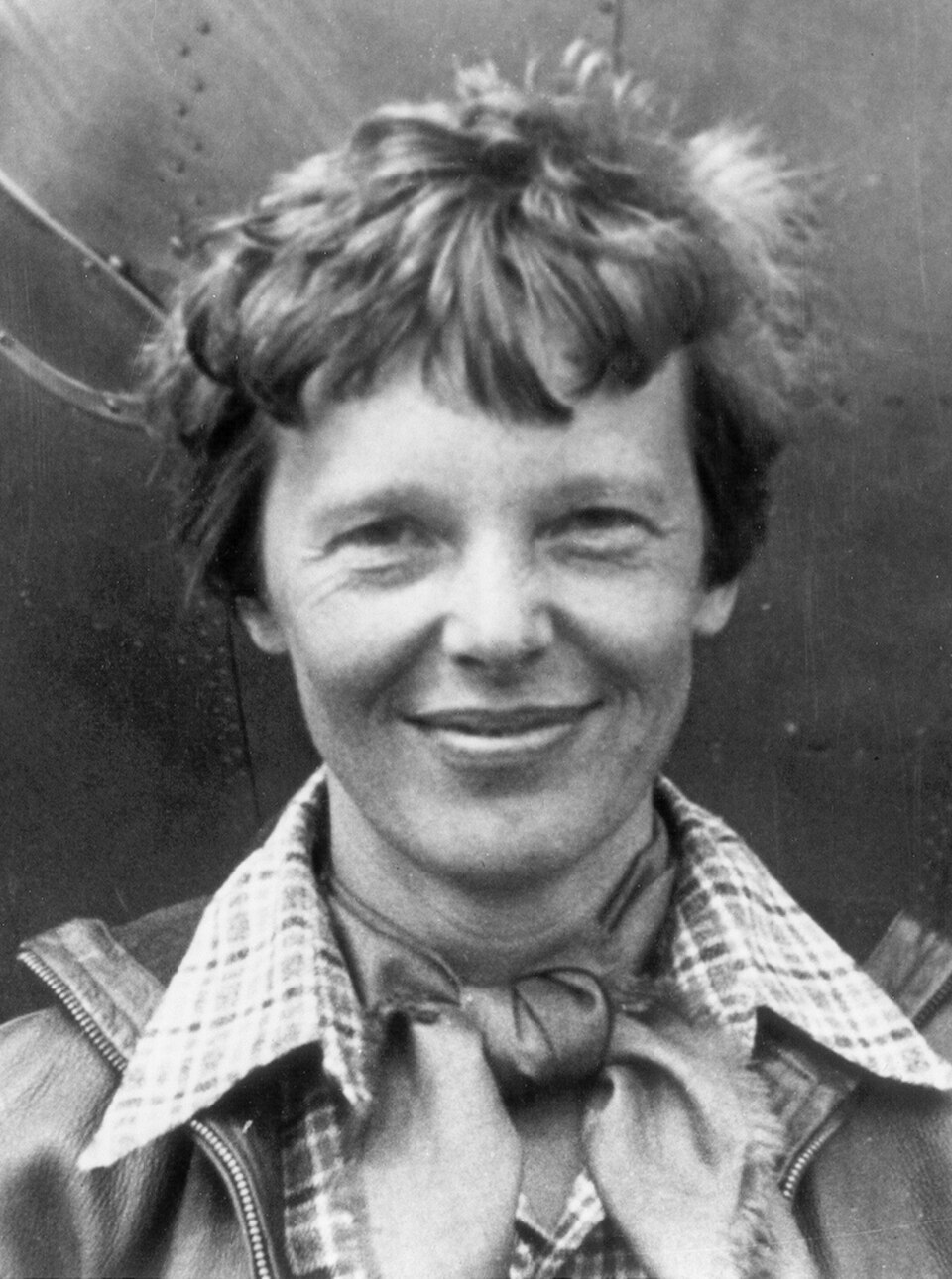
Aviation · 1897–1937
Amelia Earhart
Le fait surprenant
After her solo flight across the Atlantic she crash-landed in a field and asked the first man she met where she was. He told her she was in Ireland.
Amelia Earhart grew up in Atchison, Kansas, in a house with a big library and an unstable income, and she kept a scrapbook of newspaper clippings about women doing things that were not supposed to be for women: engineering, law, medicine. She saw her first aeroplane at the Iowa State Fair in 1908 and thought it was a thing of rusty wire and wood, not at all interesting. She trained as a nurse’s aide in Toronto and planned to study medicine.
In December 1920 a friend paid for a ten-minute flight in a small plane at Long Beach, and she knew inside ten minutes that flying was the work. She saved for lessons, took a job as a social worker to pay for the aeroplane, and in 1922 bought a second-hand Kinner Airster and set her first record, an altitude record for women pilots.
In 1928 she was invited to be a passenger on a flight across the Atlantic, the first woman to make the trip. She kept the log the whole way and resented being carried, saying later that she had been baggage. Four years later she flew it again alone, from Newfoundland to a field in Northern Ireland, the first woman and the first person since Lindbergh to cross solo, and she went on to fly solo from Hawaii to California, which had killed several people who tried it before her.
In 1937 she set out to fly round the world. Somewhere over the Pacific, between New Guinea and a tiny island called Howland, her radio calls stopped. The largest naval search ever mounted at that time found no oil slick and no wreckage, and the disappearance has drawn theories ever since, most of them more famous than the flight itself.
The records stayed. Every pilot who crosses an ocean alone is going somewhere she mapped out, and her name is still on airstrips, schools and scholarships for girls who want to fly. Her disappearance drew books and films for a century, but the thing she would probably rather be remembered for is simpler: a woman who saw a rusty machine at a fair and decided, twenty years later, to take it across the water herself.
Sources: Smithsonian National Air and Space Museum; Encyclopædia Britannica.
Le quiz
When Amelia Earhart crash-landed in a field after flying the Atlantic alone in 1932, a man walked over from the farmhouse. What did she ask him?
À demain. Trois nouveaux visages arrivent chaque matin.
Sans inscription, sans paiement. Les visages sont gratuits à lire. L’e-mail du matin arrive avec le produit complet.