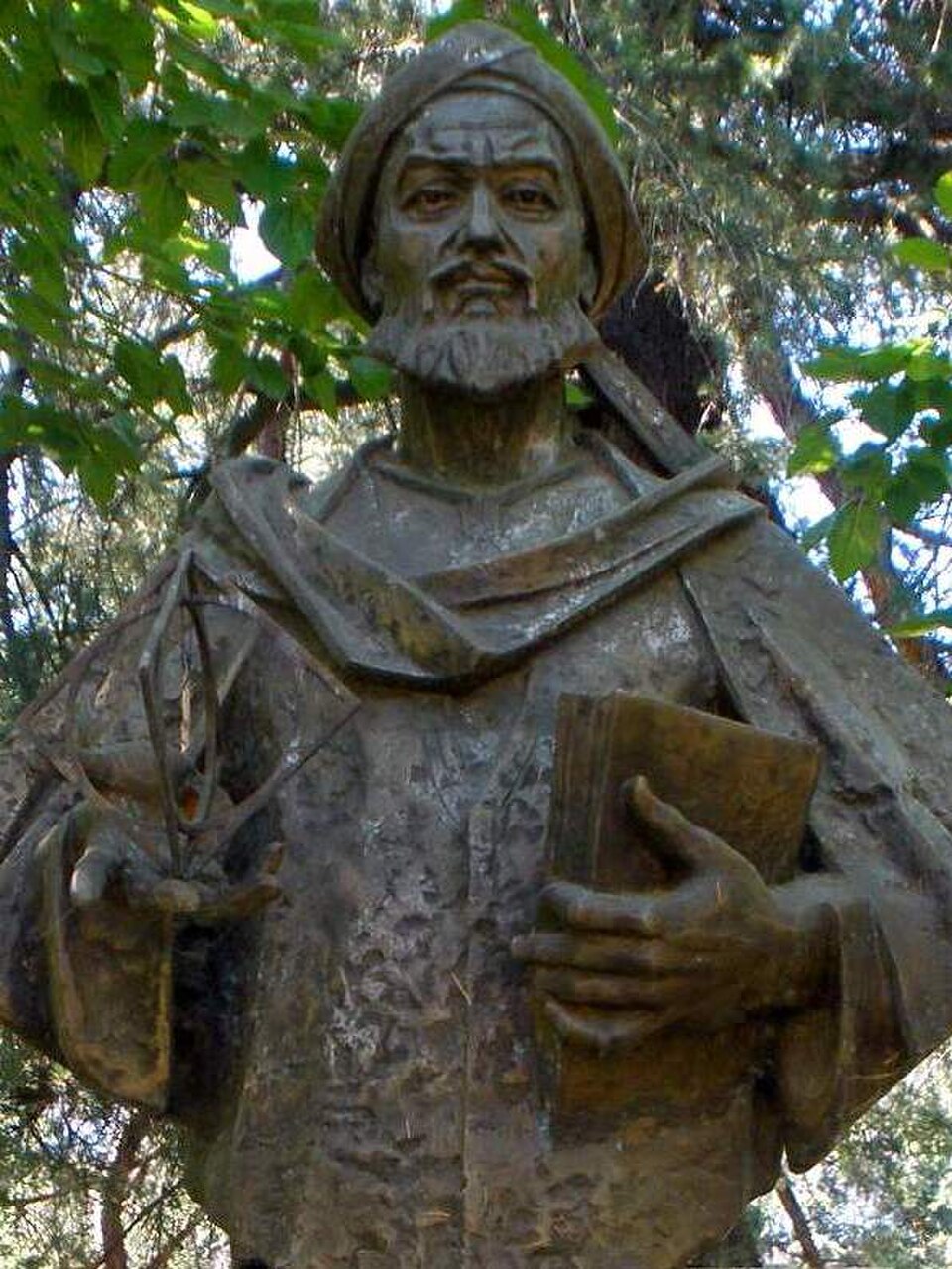
Mathematics · c. 780–850
Muhammad ibn Musa al-Khwarizmi
Surprising fact
The word algorithm is simply his name, Latinized to Algoritmi by the scribes who translated his arithmetic into Latin.
Muhammad ibn Musa al-Khwarizmi was born around 780, probably in the region of Khwarizm, the oasis country south of the Aral Sea, though nothing is recorded of his childhood and very little of his life. By the reign of the caliph al-Ma’mun he was working in Baghdad, at a court institution often called the House of Wisdom, where Greek and Persian manuscripts were collected, translated and improved. He appears in the records as an astronomer and mathematician, the author of astronomical tables, a revision of Ptolemy’s geography and a treatise on the Jewish calendar. But the two books that made his name were about numbers and equations.
The book on equations carried a long Arabic title that included the word al-jabr, the restoring of what is missing, as when a subtracted quantity is moved to the other side of an equation. The title became the book’s European name, and the word passed into English as algebra. What made the book important was not any single trick but its method: it set out, in plain words, a way of solving linear and quadratic equations step by step, with geometric proofs that the steps worked. There are no symbols; everything is spelled out in sentences. But it is, in effect, a manual for solving problems by procedure.
The other book explained how to calculate with the nine digits and the zero, the system that had come to Baghdad from India. It showed how to add, subtract, multiply and divide with a column of figures, carrying tens and borrowing, so that a tradesman could do on paper sums that once needed an abacus and a trained reckoner. When the book reached Europe in a Latin translation of the twelfth century, it opened with the words Dixit Algorizmi, said Algorizmi, the Latin form of his name. For centuries, algorism simply meant arithmetic with the new digits, done by the rules he taught.
That is how his name became a word. The Latin algorismus drifted into French, Spanish and English as the name of the decimal method, and when mathematicians later needed a term for any step-by-step procedure that reliably reaches an answer, algorithm was the word at hand. By the twentieth century it had a precise meaning, and when computers arrived it named the instructions they were given. It is a strange fate for a man whose face nobody knows and whose grave nobody has found: every sorting routine, every search query and every route a phone calculates runs on a word that is simply his name, spelled through Latin.
He died in Baghdad around 850, and the details of his life were lost so early that even the decade of his birth is a guess. His books survived the other way round: algebra was taught from Latin versions of his text for four hundred years, and the Hindu-Arabic numerals he promoted eventually displaced Roman numerals across Europe, because they made multiplication and division possible on paper. Historians of mathematics place him in the small company of writers whose work changed what ordinary people could do, not only what scholars could think. The word he gave us outlived the memory of the man who named the field it describes.
Sources: Encyclopædia Britannica; MacTutor History of Mathematics.
The quiz
Al-Khwarizmi’s name, Latinized by medieval translators, became one of the most-used words in the modern world. Which one?
See you tomorrow. Three new faces join every morning.
No signup, no payment. The faces are free to read. The morning email comes with the full product.