Astronomy · 1546–1601
Tycho Brahe
Surprising fact
He lost most of his nose in a duel at twenty, fought over a point of mathematics, and wore a metal replacement, glued on, for the rest of his life.
Tyge Ottesen Brahe, known to history as Tycho, was born in 1546 at his family’s seat in Denmark, the eldest son in one of the great noble houses of the kingdom. When he was about two, his uncle Jørgen, childless and promised a future son, simply took him from his parents’ house and kept him, and after a first angry protest his parents gave him up; he was raised in his uncle’s castle. At thirteen he entered the University of Copenhagen, and there he watched a partial solar eclipse in 1560 that had been predicted in advance. The idea that the sky could be predicted took him for life.
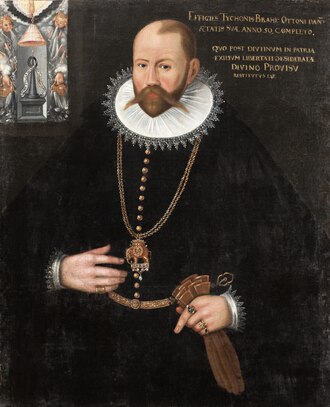
His family sent him to Leipzig to study law, and he studied astronomy instead, buying books and instruments and keeping his first notebook. In 1566, in the German town of Rostock, he lost most of his nose in a duel with a fellow Danish nobleman, a quarrel, it is said, over a point of mathematics that began at a wedding feast. For the rest of his life he wore a false nose of metal, held on with paste, and carried a small box of glue and spare noses with him. Courtiers liked to say it was gold; the men who examined his grave reported brass.
On 11 November 1572, walking home from his laboratory, he saw a new star in Cassiopeia, brighter than Jupiter, where no star had been. He measured its position nightly and showed that it lay far beyond the Moon and did not shift with the planets, which meant that change in the heavens was real. His pamphlet on the new star made him famous across Europe. King Frederick II of Denmark gave him the island of Hven and the money to build Uraniborg, a castle observatory with a printing press, a paper mill, an alchemy laboratory and a staff of students, and then an underground observatory beneath it.
For more than twenty years, from Hven, he ran the largest and most precise observatory yet built, with instruments so large and carefully made that his positions of stars and planets were accurate to about a minute of arc, several times better than anyone before him. He recorded the positions of some eight hundred stars, watched comets cross the sphere of the planets and showed they were not atmospheric, as the ancients taught, and built tables of the Sun, Moon and planets that no one could match. What he did not have was a mathematics to explain why the planets moved. In place of Copernicus he proposed that the Sun circles the Earth while the other planets circle the Sun.
When Frederick died in 1588, the young king Christian IV was far less willing to pay for a private castle observatory, and after years of quarrels Tycho left in 1597, taking his instruments and his records with him. Emperor Rudolf II installed him in Prague in 1599, where he hired a young mathematical astronomer named Johannes Kepler to work up his Mars data. In October 1601 he attended a banquet, refused out of courtesy to leave the table before his host, and died eleven days later, at fifty-four, of a urinary infection. Kepler got the notebooks, drew the laws of planetary motion out of them, and buried his patron’s own astronomy with them.
Sources: Encyclopædia Britannica; MacTutor History of Mathematics.
The quiz
Tycho Brahe, the most careful observer of his age, is remembered for a piece of his own body. What happened to it?
See you tomorrow. Three new faces join every morning.
No signup, no payment. The faces are free to read. The morning email comes with the full product.