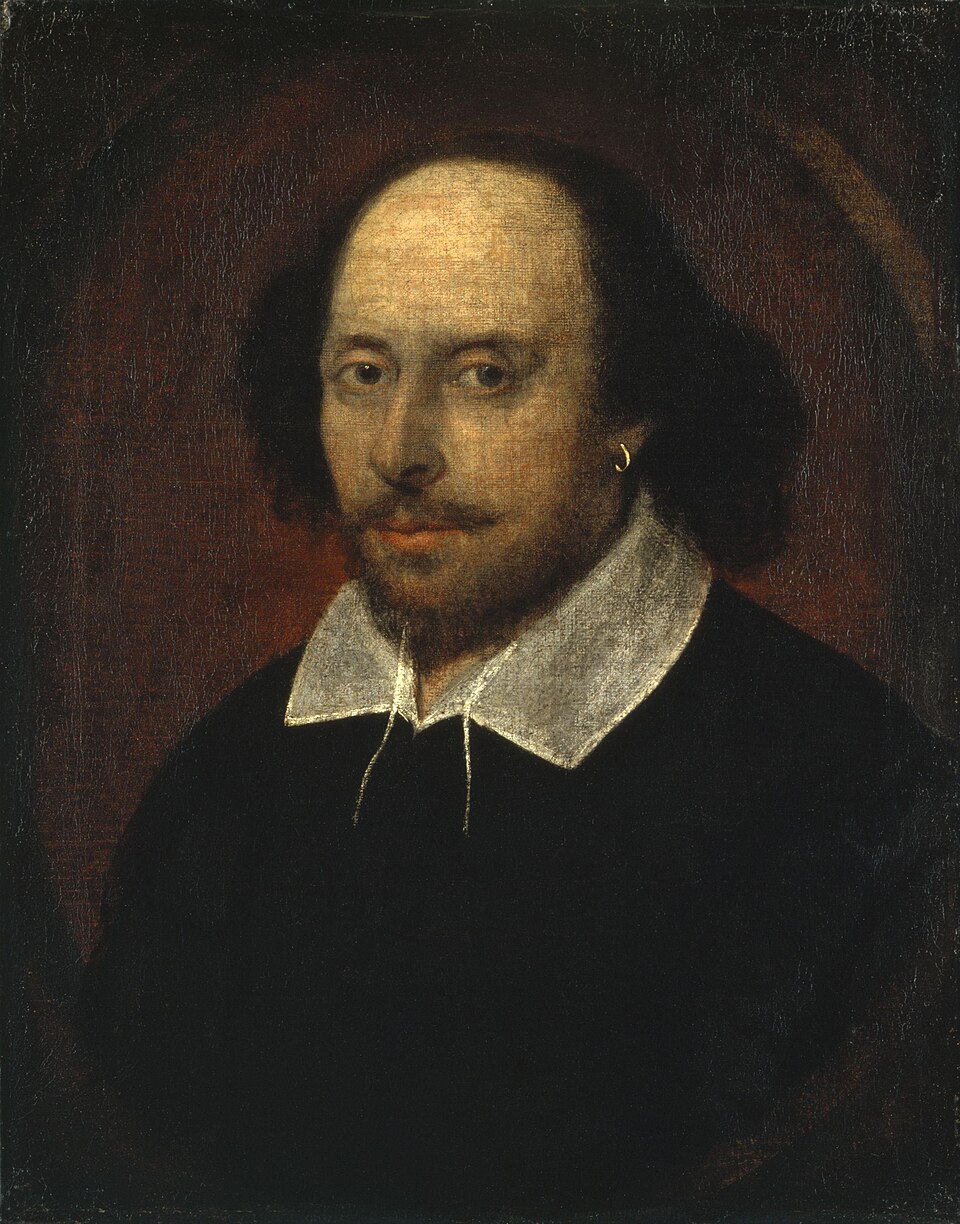
Writing · 1564–1616
William Shakespeare
El dato sorprendente
Not a single manuscript of any Shakespeare play survives in his own hand. Everything we have was printed by others.
William Shakespeare was born in Stratford-upon-Avon in 1564, the son of a glove-maker who rose to be the town’s bailiff and later fell into debt. William married Anne Hathaway at eighteen; she was twenty-six and pregnant. The records of his first years are so thin that biographers have filled the gaps with guesses for four centuries. What is certain is that by 1592 he was in London, writing plays and taking fire from a rival who called him an upstart crow.
He worked as a shareholder in a company of players, the Lord Chamberlain’s Men, which meant he was not only the writer but a business partner and an actor who took small parts. In 1599 the company built the Globe theatre across the river from the city, partly out of timber carried by night from a dismantled playhouse. When Queen Elizabeth died and the new king took over the company under his own name, the plays kept coming: Hamlet, Othello, King Lear, Macbeth, written in a burst of about four years.
What he did with the language is hard to overstate. He wrote for groundlings and scholars at once, put jokes and murders side by side, and sent ordinary speech through iambic lines until it stopped sounding strange. Words and phrases that feel as old as English itself, bedazzled, breakup, broken-hearted, wild goose chase, turn up for the first time in his pages. Critics argue over how many he coined; nobody argues that English came out of his theatre different from how it went in.
He retired to Stratford in his forties, wealthy, with the second-largest house in town. He died in April 1616, probably of a fever, leaving his wife his second-best bed in a will that mentions no plays at all. He never collected or published them himself; he seems to have thought of them as working material for a theatre, not as books.
What saved them was his friends. Two members of his company, John Heminges and Henry Condell, gathered the plays that existed in their prompt books and papers, and printed thirty-six of them in one large volume, the First Folio of 1623, seven years after his death. They said they did it so that he might go on and flourish, and only to keep the words from the press of other men who had been stealing and printing them badly. Without that book, half of Shakespeare would simply be gone.
Fuentes: Encyclopædia Britannica; British Library.
El cuestionario
Shakespeare wrote about thirty-nine plays, and not one of them would exist today but for something that happened seven years after he died. What was it?
Hasta mañana. Tres caras nuevas llegan cada mañana.
Sin registro, sin pago. Las caras son gratis para leer. El correo de la mañana llega con el producto completo.