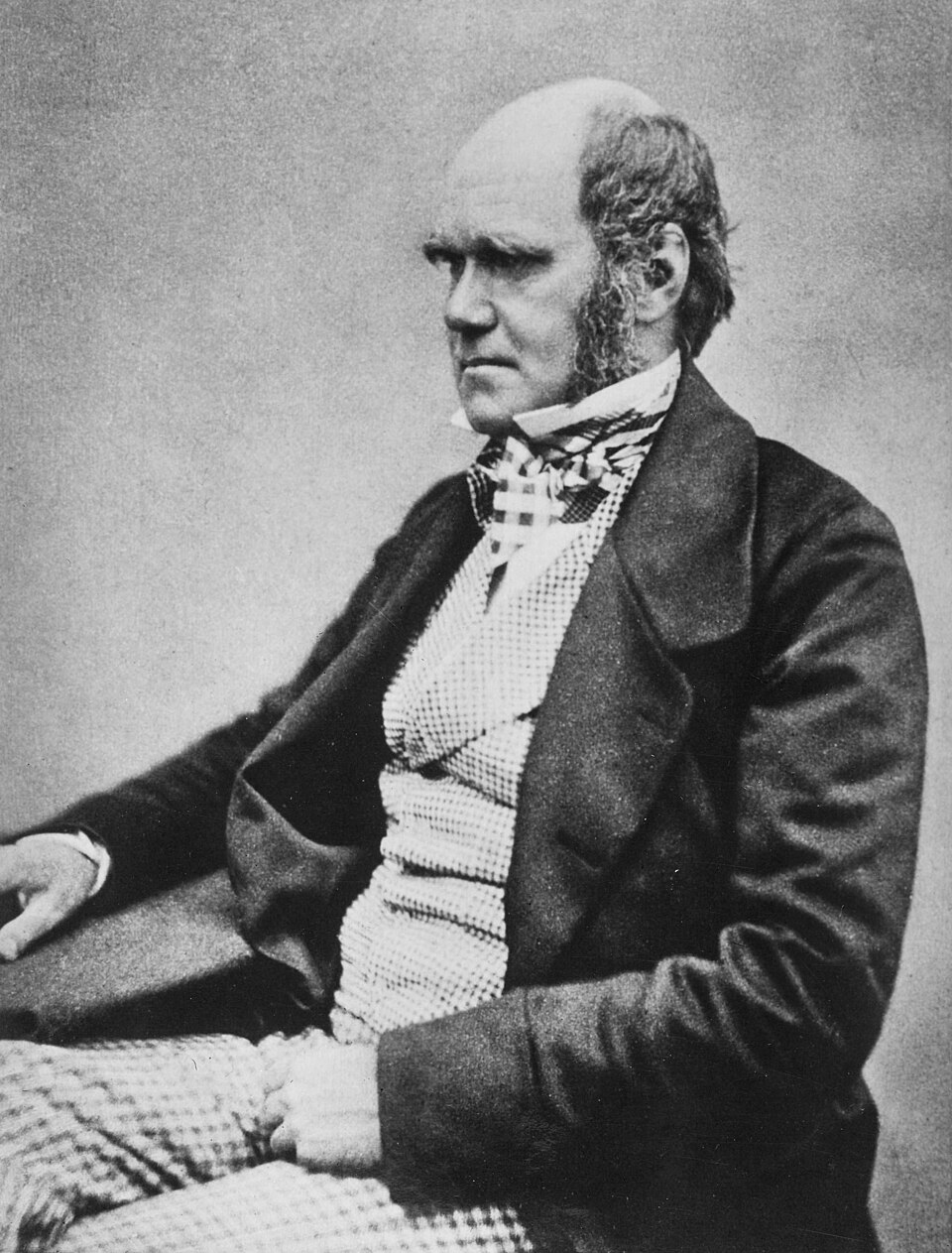
Natural history · 1809–1882
Charles Darwin
El dato sorprendente
As a Cambridge student he helped run a dining club dedicated to eating animals nobody else would serve, and on his voyage around the world he carried on, tasting armadillo, puma and rhea.
Charles Darwin was born in Shrewsbury in 1809, the second son of a rich doctor and the grandson of Erasmus Darwin, who had himself guessed at evolution. He was sent to Edinburgh to study medicine, found surgery without anesthetic unbearable, and moved to Cambridge to train for the clergy, which suited his family better than it suited him. What he really did at university was collect beetles with an enthusiasm that alarmed his cousins, and join a dining club of students who ate animals not normally served at table, including hawks, a bittern and an owl he described as indescribable.
In 1831 a Cambridge friend recommended him for a place on HMS Beagle as a gentleman companion to the captain and unpaid naturalist. The survey voyage was planned for two years and lasted five, charting coasts and sailing home the long way round. He rode inland with gauchos in Argentina, dug up giant extinct mammals, felt an earthquake in Chile, tasted armadillo, puma and rhea in the course of his sampling, and shipped home barrel after barrel of specimens and notes. The islands of the Galapagos gave him mockingbirds that differed from island to island, a detail he thought about for years afterwards.
Back in England he married his cousin Emma Wedgwood, settled at Down House in Kent, and worked out in a notebook what his evidence implied: species were not fixed, they changed, and the mechanism was the struggle for existence, in which the individuals best suited to their surroundings leave the most offspring. He read an essay by Malthus on population and watched the answer land. Then he did almost nothing with it for nearly twenty years, publishing on barnacles and breeding pigeons, suffering from an illness no doctor could name, while his theory sat in a drawer with instructions for his wife in case he died first.
What forced his hand was a letter. In 1858 Alfred Russel Wallace, working in the Malay Archipelago, sent him an essay that set out the same idea in a form Darwin recognized as his own. Friends arranged for both accounts to be read together at the Linnean Society, and Darwin hurried to finish his book. On the Origin of Species appeared in November 1859, and the first printing sold out to the book trade on its first day. The first edition never uses the word evolution; the book’s final word is evolved.
The argument divided the public, and Darwin, who disliked quarrels, stayed out of it, letting the biologist Thomas Huxley do his fighting. He followed Origin with books on orchids, on domestication, on the descent of man and on the expression of emotion, always built from patient observation rather than display. He died in 1882 at seventy-three, and against his own wishes he was buried in Westminster Abbey, near Newton and Herschel. His theory has been argued over, mended, tested and confirmed ever since; what has not changed is the kind of evidence he insisted on, gathered from the ground up, in the field.
Fuentes: Encyclopædia Britannica; Darwin Correspondence Project.
El cuestionario
As a student, Charles Darwin belonged to a club with a most unusual purpose. What did its members do?
Hasta mañana. Tres caras nuevas llegan cada mañana.
Sin registro, sin pago. Las caras son gratis para leer. El correo de la mañana llega con el producto completo.