Writing · 1802–1885
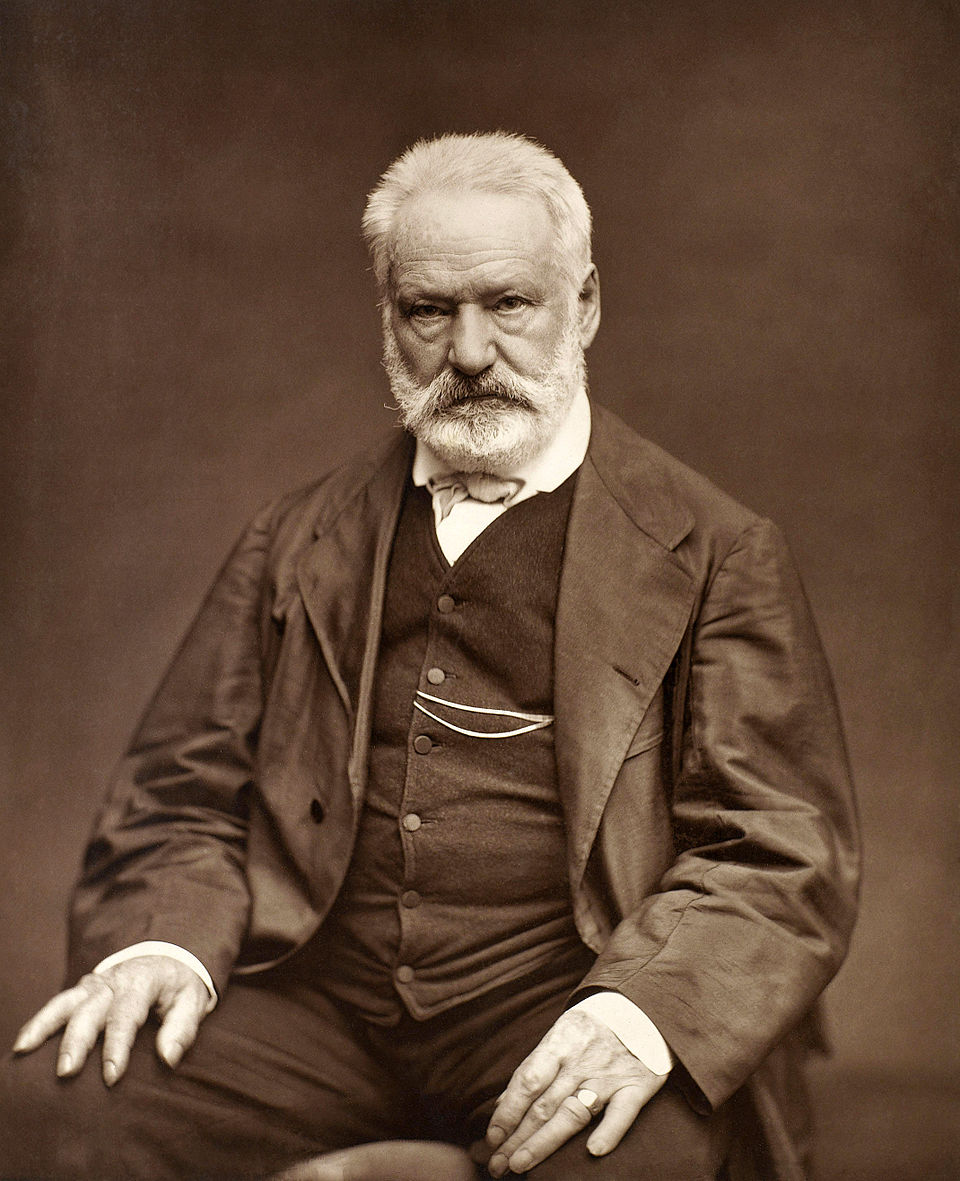
Victor Hugo
Die überraschende Tatsache
When he died in 1885 the French government closed the schools and the theatres for the funeral, and a crowd said to number two million followed his coffin to the Panthéon.
Victor Hugo was born in 1802 in Besançon, in eastern France, the son of a general of the revolutionary and Napoleonic armies and a royalist mother from Brittany. The parents separated, and the boy was shuttled between a father posted to Italy and Spain and a mother in Paris, growing up with both halves of the century arguing in his head. He was writing verse before he was a teenager. At fourteen he entered in a notebook that he wanted to be Chateaubriand or nothing, which was, at the time, the most famous living writer in France. He then set about making it true.
He married his childhood friend Adèle Foucher in 1822, and by thirty he was the leader of the young Romantics. His play Hernani had its first night in 1830 to shouting matches in the auditorium between classicists who wanted the rules kept and romantics who wanted them broken, and the romantics won. The same year he published Notre-Dame de Paris, which made the cathedral famous again and set off a national fashion for restoring old buildings. Of the children he and Adèle had, the one he loved most was Léopoldine, who drowned in the Seine in 1843 at nineteen, with her new husband. Hugo wrote almost no poetry for years afterwards.
He had been made a peer of France, and he moved steadily from royalism towards republicanism. When Louis-Napoléon seized power in December 1851, Hugo denounced him from the floor of the assembly and then fled the country, first to Brussels, then to the Channel Islands. He settled in Guernsey, in a house at the top of a street in Saint Peter Port, and he wrote standing at a desk in front of a window facing the sea, every morning, sometimes almost without pause. When the new emperor offered an amnesty in 1859, Hugo refused it with a line that made him a legend: he would come back when liberty returned to France.
The book that grew in that house had been begun years before in Paris, set aside and taken up again. Les Misérables came out in 1862, when Hugo was sixty, and readers queued for it; it was serialized, argued over, abridged, read by everyone from shop girls to statesmen, and within months it was being translated. Jean Valjean, a convict who steals a bishop’s silver and spends the rest of his life trying to deserve the kindness he is shown, has carried the argument ever since. Hugo had written in the preface to an earlier work that so long as poverty existed, a book like this one could not be useless.
He came back to Paris in 1870, when the Republic was proclaimed, and was received as a national monument while he was still alive. He sat in the Senate, kept publishing, kept a daily record of everything he ate and said, and died in May 1885 at eighty-three. He had asked for a poor man’s funeral and no religious service, and got a state funeral instead, the coffin lying in state under the Arc de Triomphe and then a procession through Paris to the Panthéon that took hours to pass any given street corner. He was, in the fullest sense, the last Frenchman whose death stopped the country.
Quellen: Encyclopædia Britannica; Maison de Victor Hugo.
Das Quiz
Hugo’s funeral in 1885 brought Paris to a standstill for days. Roughly how many people followed the coffin through the city?
Bis morgen. Drei neue Gesichter kommen jeden Morgen dazu.
Keine Anmeldung, keine Zahlung. Die Gesichter sind frei lesbar. Die Morgen-E-Mail kommt mit dem vollen Produkt.