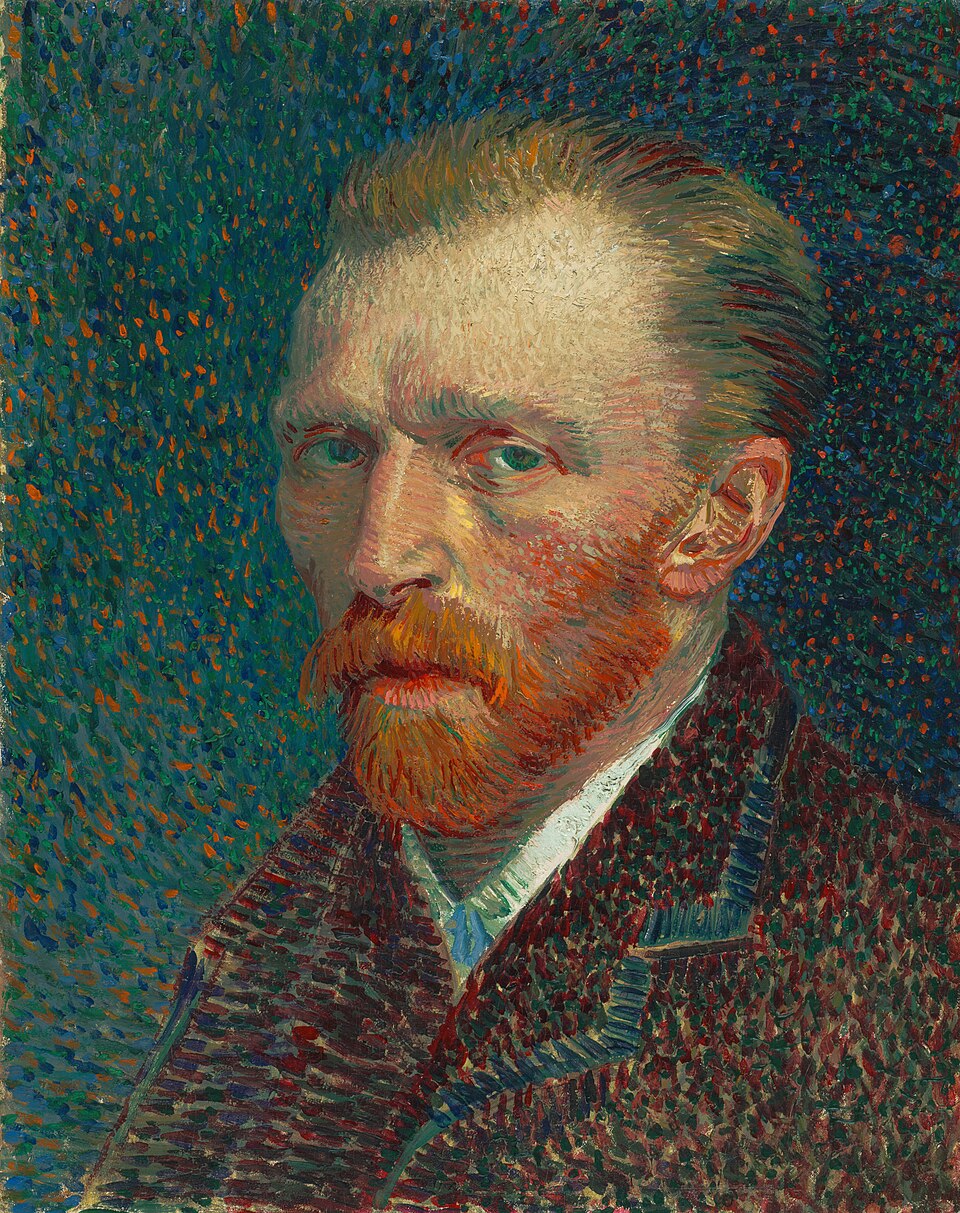
Painting · 1853–1890
Vincent van Gogh
Le fait surprenant
In ten years of painting he is thought to have sold just one work for money in his lifetime: The Red Vineyard.
Vincent van Gogh was born in 1853 in the flat farming country of Brabant, in the Netherlands, the son of a Protestant minister. He tried working in his uncle’s art gallery, was fired, tried teaching, tried preaching to coal miners in the Borinage, a ruined industrial region in Belgium, and was let go for taking the poverty of the miners too seriously. He was twenty-seven before he decided, in 1880, what he wanted to do with his life: paint.
He taught himself, drawing peasants in dark browns and greens. His first major work, The Potato Eaters, showed a family eating by lamplight, their hands heavy and honest. His brother Theo, an art dealer in Paris, sent him money all his life and kept telling him that the colours were too dark. Vincent went to Paris in 1886, saw what the impressionists were doing with light, and his palette turned almost overnight into blues and yellows.
In 1888 he moved to Arles, in the south, rented a yellow house, and painted the sunflowers, the wheat fields and the night sky of Provence at a rate of nearly a picture a day. He invited the painter Paul Gauguin to join him, dreaming of a house of artists. The two argued badly, and after a quarrel in December 1888 Vincent cut off part of his own ear. He wrapped it and gave it to a woman at a brothel, and the neighbours signed a petition saying the madman must go.
He asked to be admitted to an asylum at Saint-Rémy, painted there for a year, then moved to Auvers near Paris under the care of a country doctor. In July 1890 he shot himself in a wheat field and died two days later, at thirty-seven, with Theo holding him. The letters between the two brothers, some eight hundred of them, are the other thing he wrote: the paintings are explained there in his own words, picture by picture.
Theo died six months later, worn out, and for a while the paintings sat in boxes in an apartment in the Netherlands. Theo’s widow Johanna refused to let them stay there. She published the letters, lent the canvases to exhibitions, and argued for the work until critics came round. Within twenty years the madman of Arles was the most famous painter alive, and today a single canvas sells for more than he earned in his whole life.
Sources: Van Gogh Museum, Amsterdam; Encyclopædia Britannica.
Le quiz
Vincent van Gogh painted about 900 pictures. How many are reliably known to have been sold for money during his lifetime?
À demain. Trois nouveaux visages arrivent chaque matin.
Sans inscription, sans paiement. Les visages sont gratuits à lire. L’e-mail du matin arrive avec le produit complet.