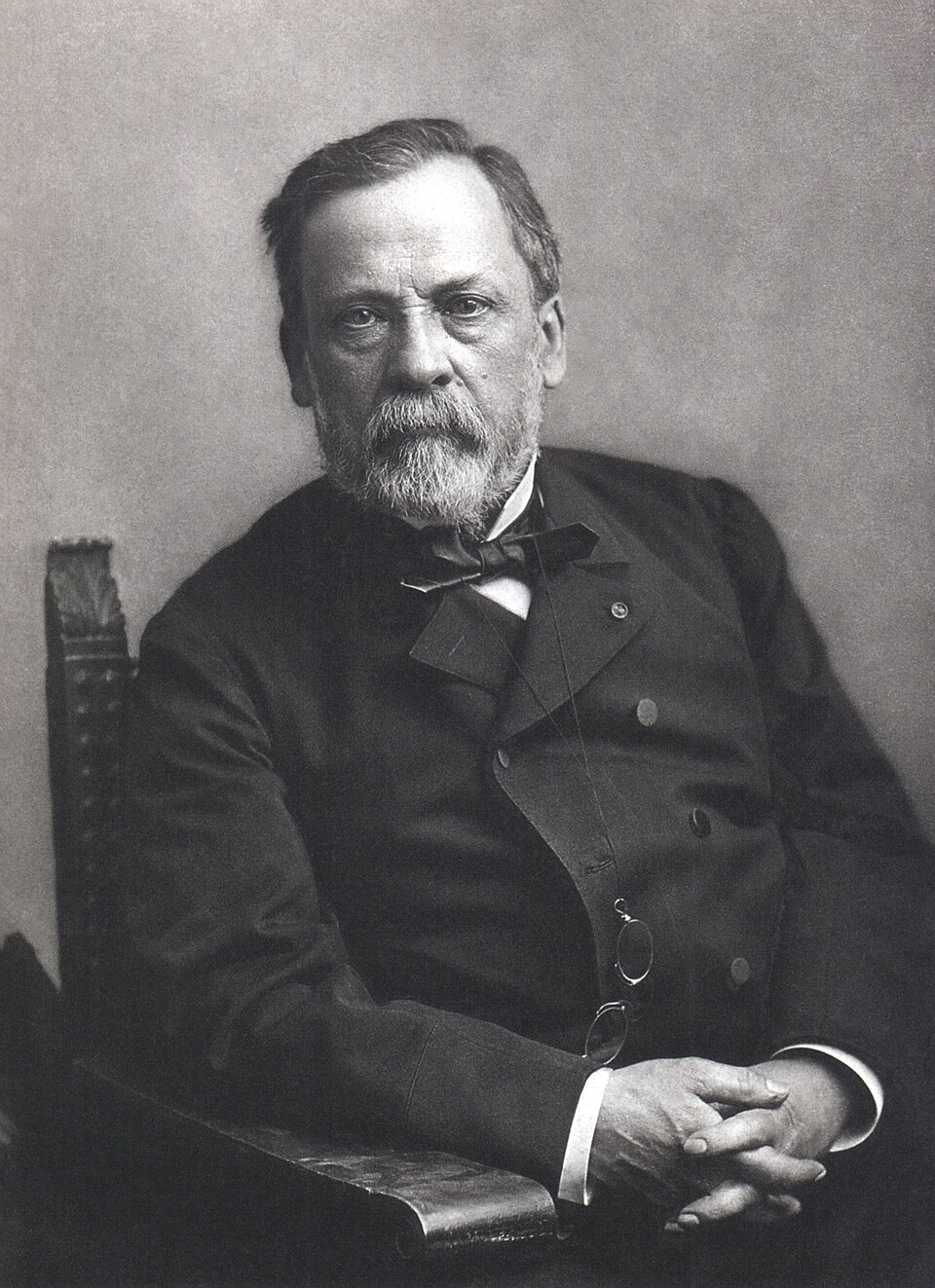
Science and medicine · 1822–1895
Louis Pasteur
Le fait surprenant
The man who proved germs cause disease and invented the rabies vaccine was not a doctor. He was a chemist.
Louis Pasteur was born in 1822 in Dôle, in eastern France, the son of a tanner who had been a sergeant under Napoleon. He was an average student at first, better at drawing than at anything else, until a chemistry teacher at the royal college in Besançon turned his head. In Paris he worked on crystals, and at twenty-six he made the discovery that made his name: two forms of the same tartaric acid crystal were mirror images of each other, identical except for the twist, and only one was produced by living things.
The wine growers of Lille came next, complaining that their fermentations were turning sour. Pasteur looked through the microscope and saw the cause: living germs, not spontaneous decay. He then built the experiment that killed an old theory outright, boiling broth in flasks with long swan-necked tubes that let air in but trapped the dust, and showing the broth stayed clear indefinitely. Life, he showed, does not arise from nothing. It comes from life.
He saved the silkworm industry of France, then the chickens, then the cattle. Working on chicken cholera, his assistant happened to leave a culture on a shelf through the summer; the weakened germs, given to healthy birds, made them immune. Pasteur saw what had happened and ran with it: protection by giving a weakened disease. He called it vaccination in honour of Edward Jenner, and demonstrated it publicly at Pouilly-le-Fort in 1881, where all the vaccinated sheep survived a lethal dose of anthrax and the unvaccinated died.
Rabies was the one that touched everyone, because it was a death sentence with a dog’s face on it. In 1885 a nine-year-old Alsatian boy, Joseph Meister, was bitten fourteen times by a rabid dog and brought to Pasteur’s door. The vaccine had never been tried on a human being. Pasteur, a chemist with no medical licence, hesitated, then injected the boy. Joseph Meister lived, and grew up to work as the gatekeeper of the institute named for Pasteur.
Pasteur had suffered a stroke in 1868 that left him partly paralysed down one side, and he did most of his greatest work afterwards, from a chair, directing experiments he could not stand over. He died in 1895 near Amiens, and the state gave him a funeral of the kind usually kept for generals. The process that bears his name still runs through every milk carton in the world, and the institute he founded in Paris still develops vaccines today.
Sources: Institut Pasteur; Encyclopædia Britannica.
Le quiz
Louis Pasteur invented the rabies vaccine and proved that germs cause disease. What was his actual training?
À demain. Trois nouveaux visages arrivent chaque matin.
Sans inscription, sans paiement. Les visages sont gratuits à lire. L’e-mail du matin arrive avec le produit complet.