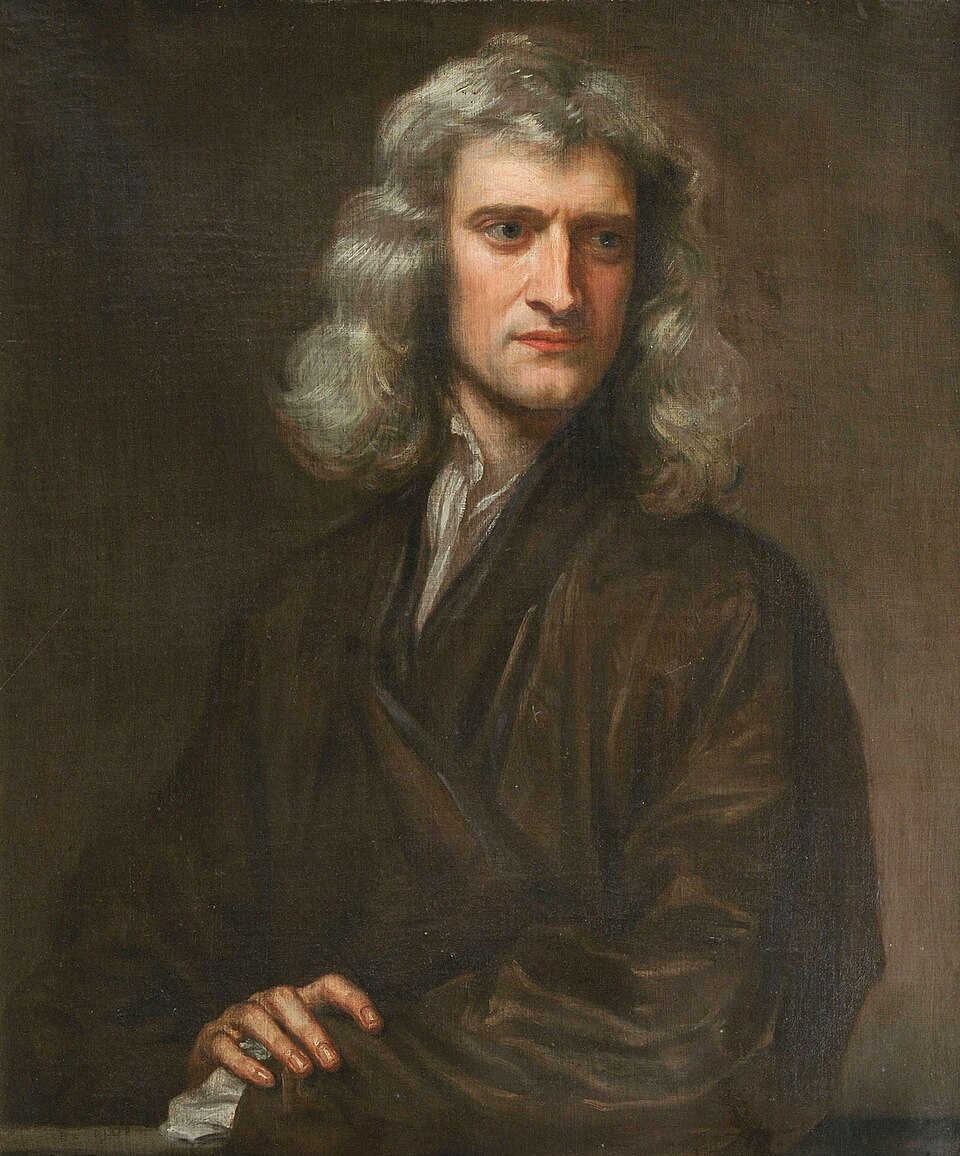
Physics and mathematics · 1643–1727
Isaac Newton
Le fait surprenant
In England, Newton was born in 1642. Most of Europe called it 1643, because England had not yet adopted the new calendar.
Isaac Newton was born on Christmas Day in 1642 by the English calendar, in a stone farmhouse in Lincolnshire, and he was so small that the family did not expect him to live the week. His father was a farmer who had died three months before. When his mother remarried, she left the boy with his grandmother, and he grew up alone with a pocketknife, making wooden clocks and a windmill with a mouse inside to turn the sails.
At nineteen he went to Cambridge, where the curriculum was still Aristotle. He kept a notebook with a page headed Plato and Aristotle and wrote under it a single line: friends of truth. Then the plague closed the university in 1665 and he went home to the farmhouse for two years. There, working by himself, he worked out calculus, broke white light into colours with a prism, and started thinking about why the Moon does not fall out of the sky.
The apple story is mostly true. He watched one drop in the orchard and asked whether the same pull that dragged it down reached as far as the Moon. It did: the same force, weakened by distance, held the Moon in its path. When the astronomer Edmond Halley heard about it he pressed Newton to write it all down, and in 1687 the Principia appeared, three laws of motion and the law of gravity, printed at Halley’s own expense.
He spent the last thirty years of his life in London instead, running the Royal Mint, where the coins came in for clipping and forgery on a scale that had the government worried. Counterfeiters were hanged for it in those years, and Newton went down to the taverns in disguise himself to catch them. He led the Royal Society for twenty-three years, published his work on optics, and argued about calculus with a German called Leibniz, who had invented the same thing without him.
The laws stayed. Three centuries of machines, bridges, rockets and planets moved by them, and engineers still calculate orbits with the book he wrote in a farmhouse while a plague kept the university shut. The apple tree in the story still has descendants growing at Cambridge, and the unit of force is named for him, so every physics student in the world writes his name down every time they push something.
Sources: Encyclopædia Britannica; Royal Society.
Le quiz
Newton was born on Christmas Day, but his birth was recorded in England as 1642 while most of Europe already called it 1643. Why?
À demain. Trois nouveaux visages arrivent chaque matin.
Sans inscription, sans paiement. Les visages sont gratuits à lire. L’e-mail du matin arrive avec le produit complet.