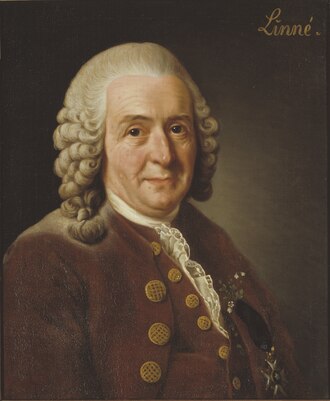
Botany · 1707–1778
Carl Linnaeus
Le fait surprenant
The man who gave every living thing its two-part name put humans in the same order of animals as the monkeys and apes, and some of his readers never forgave him.
Carl Linnaeus was born in 1707 in a small village in the Swedish province of Småland, the son of a poor country pastor with a taste for gardening. His father had taken the family name Linnaeus from a linden tree that grew on the family land, unusual in a country where most people then had no fixed surname at all. The boy was meant for the church, was a mediocre student of Latin, and did badly at everything except plants. A local doctor saw the collections he was making and paid for him to study medicine, first at Lund and then at Uppsala.
At Uppsala he made a journey in 1732 to Lapland, on horseback and on foot, to catalog the plants, animals and customs of a region then almost unknown to southern science, and came back with thousands of specimens and the Sami costume he had himself painted in. Unable to afford a Swedish degree, he took his doctorate in the Netherlands in 1735, and there he published the first edition of a thin book called Systema Naturae. It was an attempt to list every known species of plant and animal in the world, arranged in one system.
The idea that made the system work was the pair of names. Every living thing got a two-part name, genus and species, and was sorted by a nested scheme of class and order that anyone with a specimen in hand could apply. He applied it first to plants, sorting them by their stamens and pistils, a sexual system that scandalized some readers and worked well enough to spread. In 1758 he turned it on our own species, giving humans the scientific name Homo sapiens and placing them, with little comment, in the same order of animals as the monkeys and apes.
He returned to Sweden in 1738, married, set up as a doctor in Stockholm, and in 1741 was made professor at Uppsala, where he rebuilt the botanical garden and sent his best students out to the corners of the world. He called them his apostles. Several died in the field, Forsskål in Arabia and Tärnström on a voyage to China; others, like Solander, who sailed with Captain Cook, and Thunberg, who reached Japan, came home with collections that made the system work. In his lecture garden he could name a plant at sight, and his examinations included plant-hunting expeditions into the fields around Uppsala.
The crown made him a nobleman in 1761 and he took the name Carl von Linné. After two strokes he could no longer teach, and he died in 1778. His books, specimens and correspondence were bought four years later by a young English naturalist, James Edward Smith, and taken to London, where the Linnean Society was founded to keep them; they are still there, and botanists still consult his specimen sheets. Every scientific name of every species on Earth is still built the way he built it, two names, one animal, one plant, genus and species, in a single list that keeps growing.
Sources: Encyclopædia Britannica; Linnean Society of London.
Le quiz
Carl Linnaeus gave our species its scientific name. Where did he file humans in his system of nature?
À demain. Trois nouveaux visages arrivent chaque matin.
Sans inscription, sans paiement. Les visages sont gratuits à lire. L’e-mail du matin arrive avec le produit complet.