Journalism · 1864–1922
Nellie Bly
Surprising fact
She got around the world in seventy-two days, beating the eighty-day fictional record of Jules Verne’s Phileas Fogg.
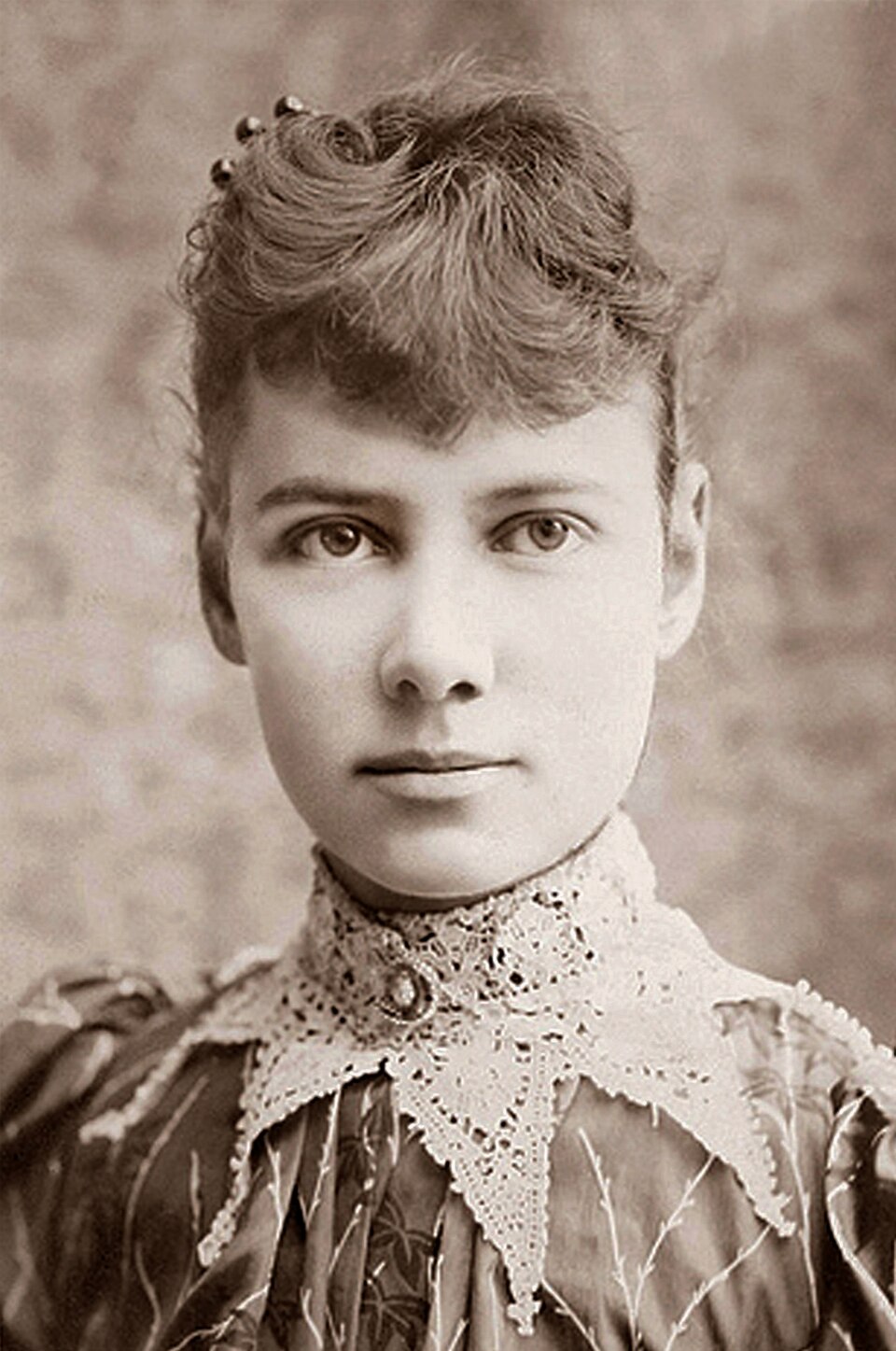
Nellie Bly was born Elizabeth Cochran in Pennsylvania in 1864. When a Pittsburgh newspaper printed a column telling that women belonged in the home, she wrote in to say so, under a pen name taken from a Stephen Foster song. The editor was impressed enough to offer her a job, and when he assigned her to the gardening page she left for New York with almost no money and talked her way into the newsroom of the World.
The World sent her somewhere no editor had thought to send a reporter. In 1887 she had herself committed to the asylum on Blackwell’s Island, where New York kept the poor and the sick and a great many women who were simply inconvenient, and she wrote from the inside for ten days. The series ran as Ten Days in a Mad-House, the city panicked, and the money for the women’s care was increased the same year.
Two years later the paper had a better idea. Jules Verne had written about a man going round the world in eighty days, and the World wanted to know how long a real woman would take. She sailed from New York in November 1889 with one small bag and came back in seventy-two days, six hours and eleven minutes, greeted by crowds and fireworks along the way, famous on two continents.
She married a millionaire factory owner, took over the company when he died and ran it for years, redesigning the milk cans and garbage cans it made, then went back to reporting, covering the Eastern Front in the First World War and filing from Europe until the end. She died in New York in 1922, aged fifty-seven, still working on a story the week before.
The reporting stayed. The kind of journalism that goes where the story is and stays there, in the asylum, on the ship, in the trench, still gets described as doing a Nellie Bly, and every American competition for young reporters carries her name. The World printed a game board of her trip, and the asylum she wrote from is gone; the ten days are still the standard for what a reporter should be willing to do.
Sources: Encyclopædia Britannica; New-York Historical Society.
The quiz
In 1889 the New York World sent Nellie Bly round the world to see how long it would take in real life, not in Jules Verne’s novel. What did she manage?
See you tomorrow. Three new faces join every morning.
No signup, no payment. The faces are free to read. The morning email comes with the full product.