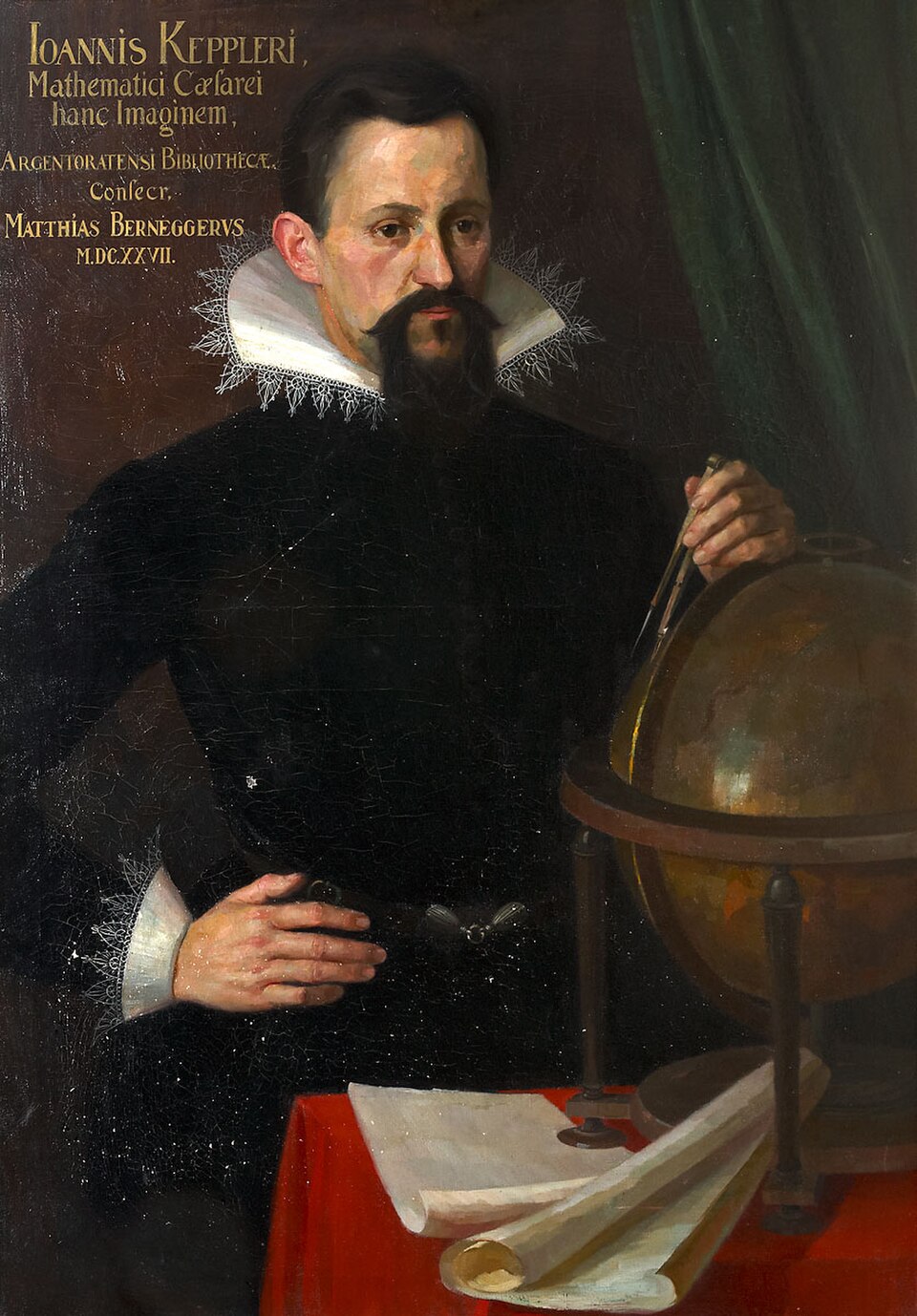
Astronomy · 1571–1630
Johannes Kepler
Surprising fact
In the middle of his work on the planets he took over the defense of his own mother, on trial for witchcraft, and got her released.
Johannes Kepler was born in 1571 in the free imperial town of Weil der Stadt, in southwest Germany, son of a mercenary soldier who vanished and a mother who kept an inn, where the boy helped out from the age of five. Smallpox in childhood left him with weak eyes and crooked hands, which mattered, because astronomy was what he wanted to do. A scholarship to the Lutheran university at Tübingen saved him. There he learned the Copernican system from a teacher who believed it, and defended it in public disputations, which the church authorities noticed and did not approve of.
He was sent away to teach mathematics at a provincial school in Graz, where in 1596 he published a first book, an attempt to show that the spacing of the six known planets was governed by the five perfect solids of geometry nested one inside another. The scheme was wrong, but it was the work of a mind that looked for law, and he sent it to the astronomer he most admired, Tycho Brahe, then the best observer in Europe. When the Catholic authorities ordered the Protestants out of Graz in 1600, Kepler had nowhere to go, and Tycho invited him to Prague.
They argued for a year and a half and needed each other. Tycho had twenty years of the most accurate planetary observations ever made; Kepler had the mathematics to do something with them. When Tycho died in 1601, Kepler was appointed imperial mathematician to the emperor in his place, and inherited the notebooks on condition that he publish what they showed. For years he struggled to fit the orbit of Mars into circles, failed, and admitted in print in 1609 what the data demanded: planets move in ellipses, with the Sun at one focus, sweeping out equal areas in equal times.
Nine years later, in a book on cosmic harmony, he added a third law relating the time a planet takes to orbit to its distance from the Sun, and published the Rudolphine Tables, planetary predictions built on Tycho’s measurements that remained the best in Europe for a century. In between he wrote a treatise on the optics of the telescope, a short book on the six-cornered shape of snowflakes that helped found crystallography, and a strange fiction about a voyage to the Moon, Somnium, in which the Earth is seen from above as just another wandering star. The universe, he believed and wrote, is lawful and geometric.
From 1615 to 1621 he fought a case that had nothing to do with astronomy: his elderly mother Katharina was accused of witchcraft in her village, chained in a cell and threatened with torture, and Kepler, taking over her defense personally, got the case thrown out and had her released; she died within the year. He himself, a Lutheran, was barred from communion by his own church. He died in Regensburg in 1630, on a journey to collect money owed him by the imperial court, and was buried in a churchyard whose location is now lost. Newton explained his three laws, eighty years on, with gravity.
Sources: Encyclopædia Britannica; MacTutor History of Mathematics.
The quiz
While working out the laws of planetary motion, Johannes Kepler spent years fighting a case of a very personal kind. What was it?
See you tomorrow. Three new faces join every morning.
No signup, no payment. The faces are free to read. The morning email comes with the full product.