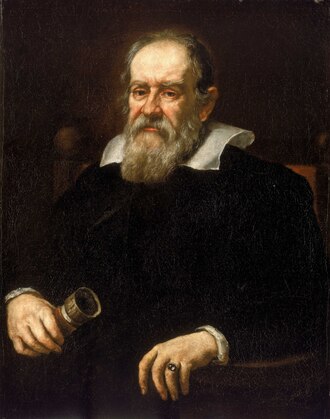
Astronomy · 1564–1642
Galileo Galilei
Surprising fact
One of Galileo’s fingers was taken as a relic when his body was moved in 1737, and it sits today in a glass case in a museum in Florence.
Galileo Galilei was born in Pisa in 1564, the year Shakespeare was born and Michelangelo died. His father was a lutenist and a music theorist who wrote learnedly about harmony, and he wanted his son to have a proper profession, so Galileo was sent to study medicine at the University of Pisa. He was bored by it, was drawn instead to mathematics, and left without a degree. At twenty-five he was back at the same university as a lecturer in mathematics, and in 1592 he took the better-paid chair at Padua, in the republic of Venice, where he taught for eighteen years.
In 1609 he heard that a Dutch spectacle-maker had invented a device for seeing far things near, and he built his own version, better than any then available, and turned it on the sky instead of on ships. Within a year he had seen mountains on the Moon, stars too faint for the naked eye, and four small bodies circling Jupiter that no one had noticed before. He named them the Medicean stars, after the grand duke of Tuscany, who promptly made him his mathematician and philosopher. The little book he called the Starry Messenger made him the most famous scientist in Europe.
He was not punished for the moons of Jupiter; he was punished for what he wrote about the Earth. Copernicus had proposed that the Sun stands still and the Earth moves, and Galileo argued in print that the telescope made the old objections fail. In 1616 the Church ordered him to hold the theory as a hypothesis only. In 1632 he published a dialogue in which the character defending the traditional view is made to look a fool. He was tried in Rome in 1633, at sixty-nine, condemned as suspected of heresy, made to abjure on his knees, and sentenced to house arrest.
The house arrest was his own villa at Arcetri, above Florence, watched but not harsh, though he was not allowed to publish. There, going blind, he dictated his last book, Two New Sciences, on falling bodies and the strength of materials, which was smuggled out and printed in Holland in 1638. In it he worked out the law that bodies fall with the same acceleration whatever their weight, and described the experiments with inclined planes and pendulums that made modern physics possible. He died there in 1642, still under sentence, and still arguing with former friends who had abandoned him.
The grand duke wanted him buried in the pantheon of Santa Croce in Florence; the Church objected, and he was laid in a side room until 1737, when his body was moved to the grand monument. When it was shifted, three fingers, a tooth and a vertebra were taken as keepsakes, and one of the fingers is on display to this day in a glass case at the Museo Galileo in Florence. In 1992, after a commission spent more than a decade studying the case, Pope John Paul II conceded that the judges of 1633 had been wrong.
Sources: Encyclopædia Britannica; Museo Galileo.
The quiz
Galileo died under house arrest in 1642, and one of his fingers survives as a keepsake. Where can you see it today?
See you tomorrow. Three new faces join every morning.
No signup, no payment. The faces are free to read. The morning email comes with the full product.