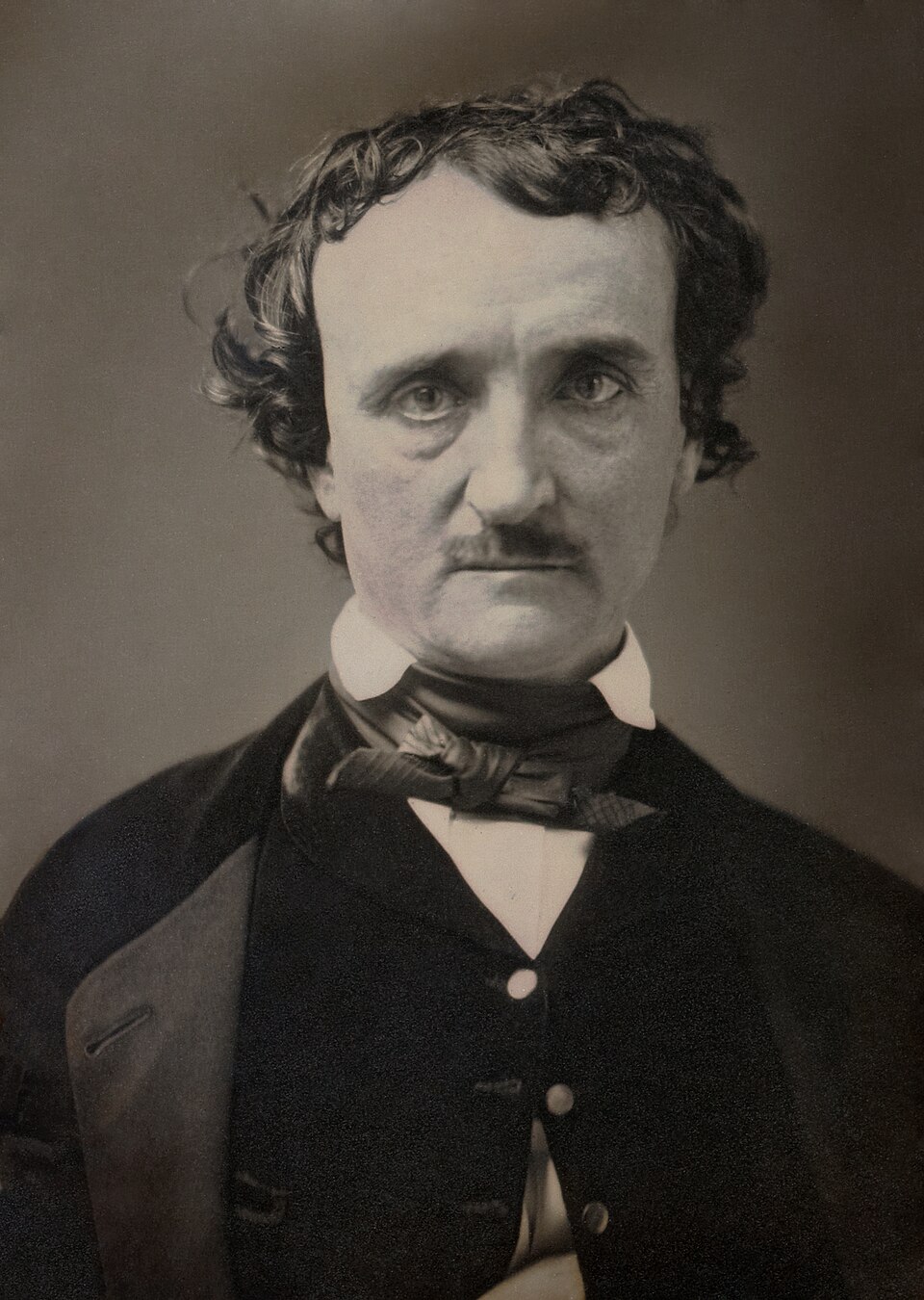
Writing · 1809–1849
Edgar Allan Poe
Surprising fact
Poe invented the detective story in 1841, eight years before the word detective was even added to the dictionary.
Edgar Allan Poe was born in Boston in 1809 to actors, and by three he was an orphan. A Richmond tobacco merchant named John Allan took him in, never adopted him, and paid for his schooling in England and Virginia while the two of them quarrelled about money. Poe gambled his allowance at the University of Virginia, was thrown out, ran off to Boston to publish a book of poems nobody bought, and was expelled from West Point for getting himself deliberately court-martialled.
Then he settled to the only work he was ever any good at. He edited magazines in Philadelphia and New York, wrote reviews that made enemies across American letters, and earned almost nothing, moving house every year or two with his wife Virginia, who was his thirteen-year-old cousin when he married her and died of tuberculosis ten years later, at twenty-four. He wrote The Raven in 1845, and it made him famous in a week without making him rich: the magazine paid him about nine dollars for it.
The work changed stories. In 1841 he published The Murders in the Rue Morgue, about a man named Auguste Dupin who solves a locked-room killing by thinking, with a narrator friend asking the questions, and that shape, detective, witness, the wrong suspect, the explanation at the end, was borrowed whole by Arthur Conan Doyle for Sherlock Holmes forty years later. He also wrote the horror and the science fiction that came after him, from Verne to Lovecraft, in about twenty years of work.
He died in Baltimore in October 1849, at forty, after disappearing for six days on a trip to New York. He was found in a tavern in someone else’s clothes, in a state he could not explain, and he said one repeated word, Reynolds, before dying in hospital. Nobody has ever established what killed him: the alcohol, the illness, or the voting gangs who used men like him for the day.
The stories stayed. The Edgar Award, given every year to the best mystery writing in America, is a small statue of him, and the locked room he invented is still the room every detective writer has to get out of. Poe never had a magazine of his own, never earned more than a working wage, and is read more now than any of the editors who paid him nine dollars a poem.
Sources: Encyclopædia Britannica; Edgar Allan Poe Society of Baltimore.
The quiz
When Edgar Allan Poe was found in Baltimore in 1849, six days after he disappeared, something about him struck everyone who saw him. What?
See you tomorrow. Three new faces join every morning.
No signup, no payment. The faces are free to read. The morning email comes with the full product.