Mathematics · 1887–1920
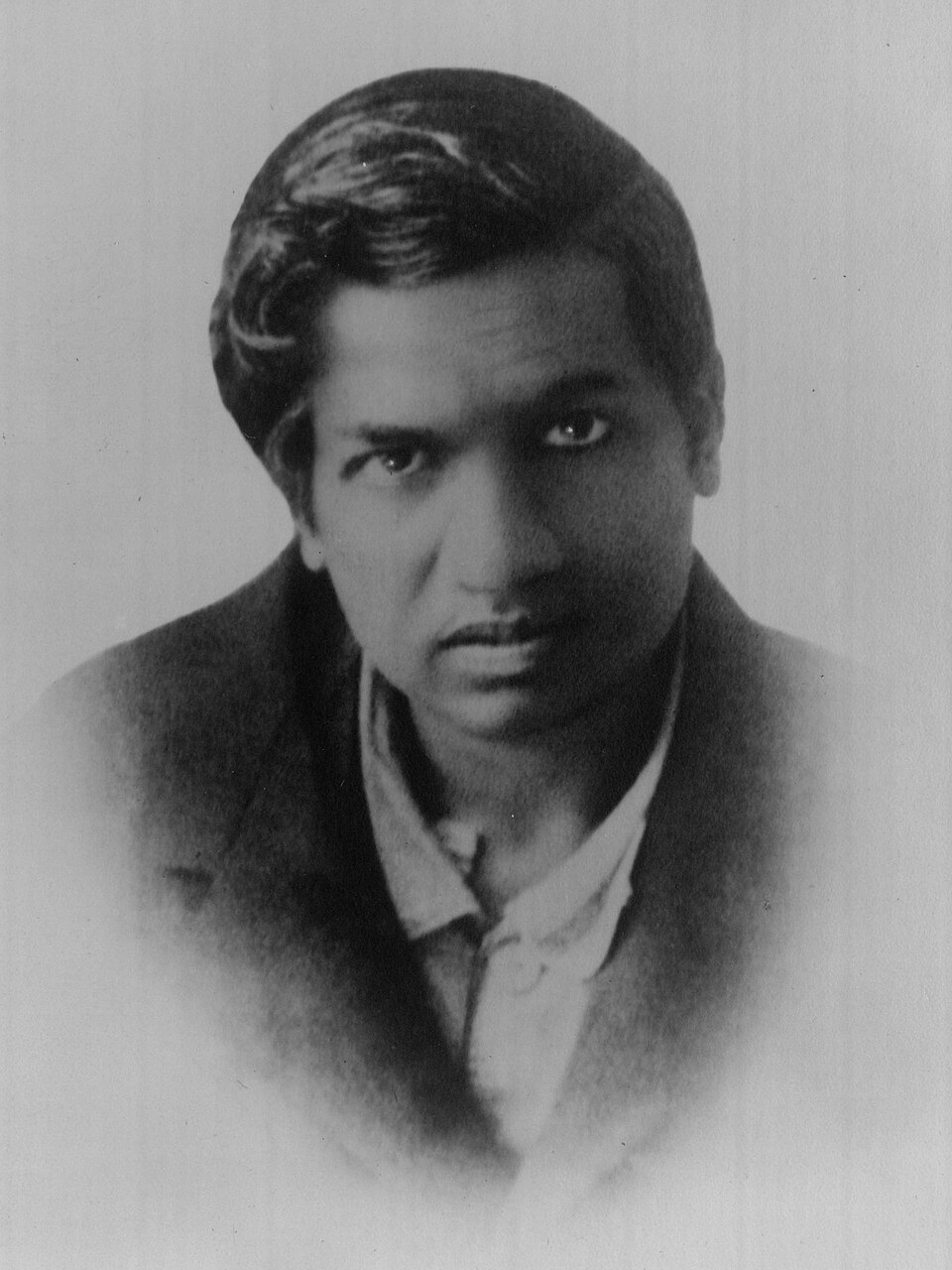
Srinivasa Ramanujan
Die überraschende Tatsache
A letter Ramanujan mailed to a Cambridge professor in 1913 arrived with no proof and no explanation, only pages of theorems he had found by himself.
Srinivasa Ramanujan was born in 1887 in a small town in Tamil Nadu, in southern India, into a family of very little money. He taught himself mathematics from one borrowed book, a school text that listed thousands of results with no explanations, and worked out for himself why every one of them was true. By the time he sat for college he could do the maths better than his examiners and nothing else well enough to pass, and he lost two scholarships and a job because of it.
In 1912 he was working as a clerk in the port office in Madras, filling notebooks with theorems in the evenings. On the advice of people who had seen the notebooks, he wrote to three English mathematicians. Two did not reply. The third, G. H. Hardy at Cambridge, opened an envelope with no proofs in it and sat down with a colleague to decide whether the sender was a crank or a genius. By the end of the evening they had decided genius, and Hardy arranged for him to come to England.
Ramanujan arrived in 1914, a Brahmin vegetarian in wartime Cambridge, cooking his own food, walking to lectures in the cold. In five years he and Hardy produced work on number theory, partitions and infinite series that is still being unpacked, and he became one of the youngest Fellows of the Royal Society ever elected. Hardy said later that the taxicab number conversation had happened by accident: he mentioned a dull ride in a cab numbered 1729, and Ramanujan said it was the smallest number that is the sum of two cubes in two different ways.
He was ill for much of the Cambridge years, probably a severe vitamin deficiency from a wartime diet that had almost nothing in it for a vegetarian, and he worked through it at the rate of a page an hour. In 1919 he went home to India, very thin and tired, and died the following April in Madras. He was thirty-two. He left behind three notebooks of results, many without proofs, that mathematicians spent the rest of the century working through.
The notebooks stayed. In 1976 a fourth one turned up in a library box in Cambridge, stuffed behind a pile of old papers, and its contents are still being turned into proofs today. The formulas he wrote for partitions, series and approximations now turn up in computer science and physics, one hundred years after a clerk in Madras wrote them down from scratch, in a book he taught himself from.
Quellen: Encyclopædia Britannica; Trinity College, Cambridge.
Das Quiz
Hardy once mentioned to Ramanujan that his taxi had a dull number, 1729. Ramanujan said at once that it was not dull at all. Why not?
Bis morgen. Drei neue Gesichter kommen jeden Morgen dazu.
Keine Anmeldung, keine Zahlung. Die Gesichter sind frei lesbar. Die Morgen-E-Mail kommt mit dem vollen Produkt.