Physics · 1791–1867
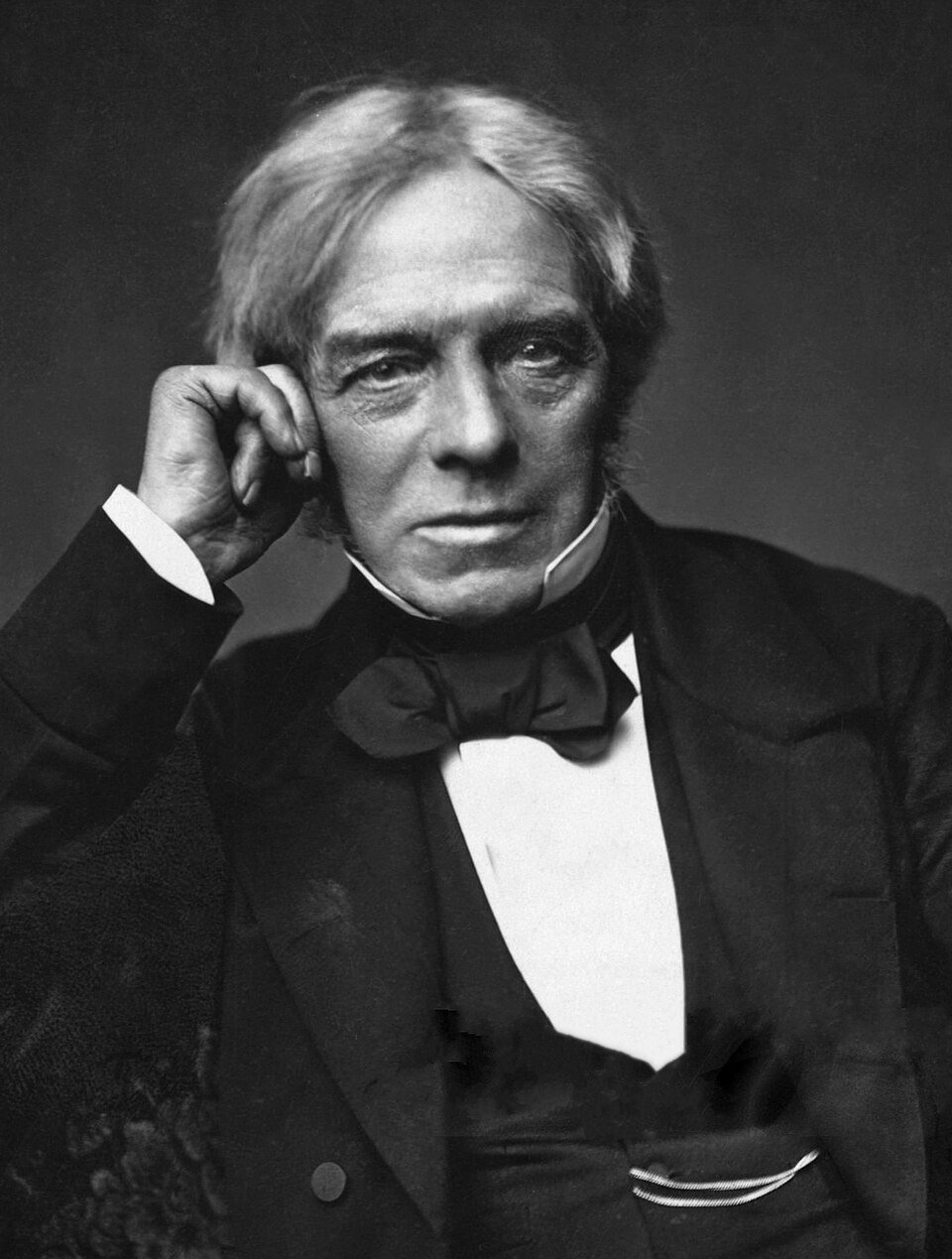
Michael Faraday
Die überraschende Tatsache
He declined a knighthood and, twice, the presidency of the Royal Society, preferring to stay plain Michael Faraday.
Michael Faraday was born in 1791 in a poor district of south London, the third of four children of a blacksmith from the north of England who had come south looking for work. He was sent out at thirteen as an errand boy for a bookbinder, and then apprenticed to the trade. For a boy with no schooling in mathematics that was a strange piece of luck: among the books he bound were an encyclopedia and an article on electricity, and he read what he bound. A customer who noticed him reading paid for a ticket to four lectures by Humphry Davy at the Royal Institution.
Faraday took notes, bound them, and sent them to Davy with a request for work. In 1813, after a laboratory accident had damaged Davy’s eyes, Davy took him on as a laboratory assistant at twenty-five shillings a week and took him along on a tour of Europe as valet and secretary, where Faraday washed bottles, met the chemists of Paris and Italy, and learned how science was done. Back at the Royal Institution he rose the only way a laboratory allows, by doing the work: he made new compounds of chlorine and carbon, liquefied several gases, and isolated benzene from oily mixtures.
His great work was electricity. In 1821 he built a device in which a wire carrying a current rotated around a magnet, the first conversion of electricity into motion. Ten years later, in 1831, he found the reverse: moving a magnet near a wire generates a current in the wire. Electromagnetic induction is the principle behind every generator and transformer in the world, and the dynamo he demonstrated in the basement of the Royal Institution is the ancestor of the electrical machines that now run everything. He lacked the mathematics to describe it, so he drew lines of force instead, and the field concept he invented that way is still how physics talks about such things.
He turned down work he thought wrong. During the Crimean War the government asked him to help develop chemical weapons, and he refused. He took out no patents, saying he was working for knowledge, and for nearly twenty years he gave the Christmas Lectures for children at the Royal Institution, the series that still runs each year. He belonged to a small Christian congregation, the Sandemanians, served it as an elder, and married Sarah Barnard, whose family worshipped there too. The man who mapped electricity had begun as a bookbinder and never stopped thinking of experiments as work done with the hands.
In 1857 he was offered the presidency of the Royal Society and declined it; asked again in 1864, he declined again. A knighthood was offered too, and he turned that down as well, saying he preferred to remain plain Michael Faraday. His memory began to fail in his sixties and he worked more slowly, but he did not stop. The Queen gave him a house at Hampton Court to live in, rent-free, and he died there in 1867. Einstein later kept his portrait on the wall of his study beside Newton and Maxwell, which is roughly the shortest summary of what he did.
Quellen: Encyclopædia Britannica; Royal Institution.
Das Quiz
Michael Faraday founded the science of electromagnetism. When his country offered him its highest honors, what did he do?
Bis morgen. Drei neue Gesichter kommen jeden Morgen dazu.
Keine Anmeldung, keine Zahlung. Die Gesichter sind frei lesbar. Die Morgen-E-Mail kommt mit dem vollen Produkt.