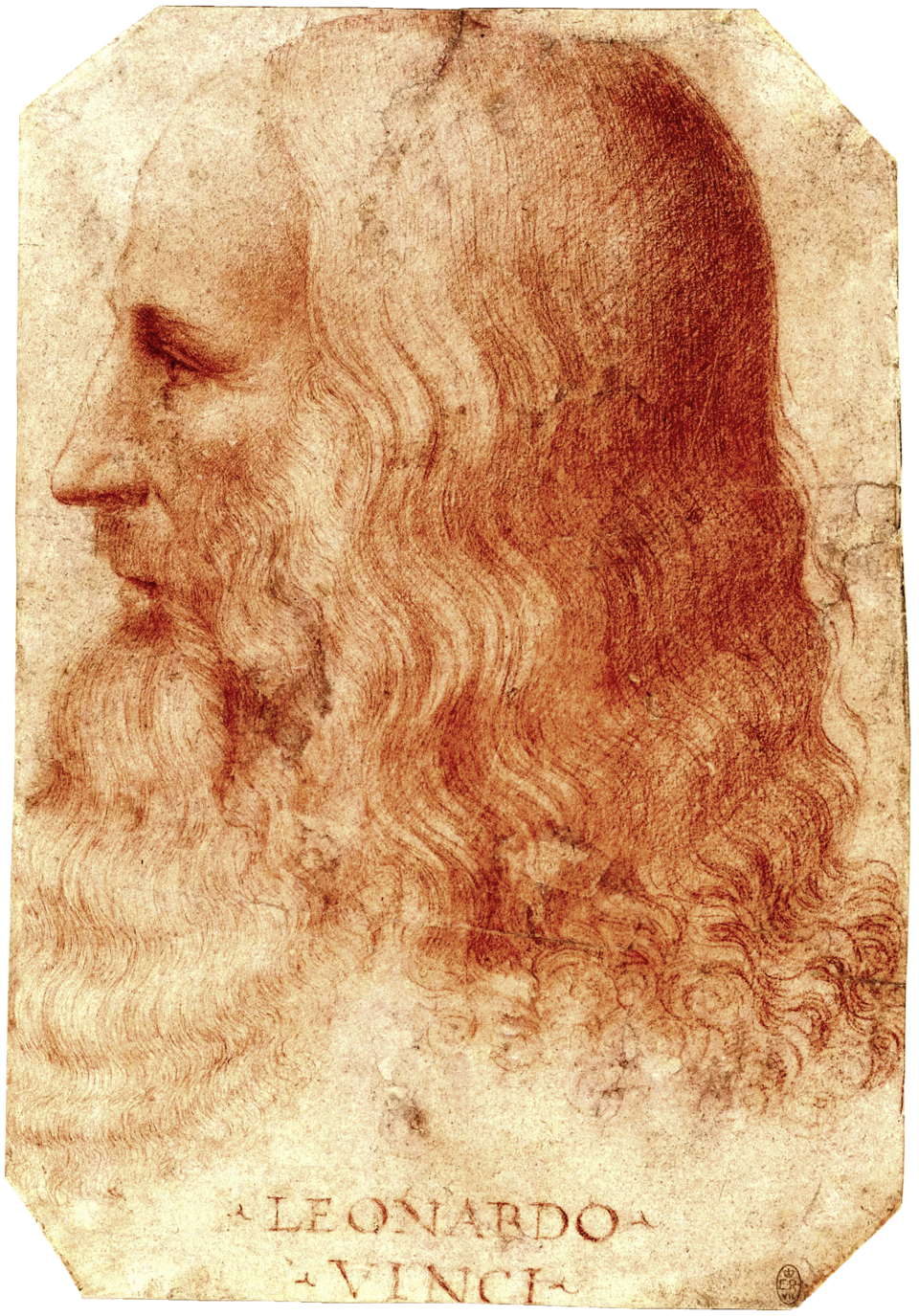
Art and invention · 1452–1519
Leonardo da Vinci
Die überraschende Tatsache
He wrote his notebooks back to front, in mirror script that reads easily only in a reflection.
Leonardo was born in 1452 near the hill town of Vinci, the illegitimate son of a notary and a peasant woman, which meant the family trade was closed to him. His father took him to Florence instead, and at about fourteen he was apprenticed to the painter Verrocchio. There he learned casting, metalwork, carpentry and paint in the same workshop. The story goes that when the young apprentice painted an angel in Verrocchio’s picture of a baptism, the teacher put down his own brush and never painted again.
At thirty he moved to Milan and offered the ruler there a curious catalogue of skills: bridge-building, cannon design, tunnel-digging, siege machines. Painting came ninth on the list, almost as an afterthought. He stayed seventeen years, painting The Last Supper on a refectory wall, working slowly and often not at all, and filling notebooks with drawings of flying machines, pumps, sails and the muscles of a horse he was commissioned to cast in bronze and never did.
The notebooks run to thousands of pages, written in mirror script from the right edge of the page backwards. Nobody is quite sure why he wrote that way, though it may simply have been comfortable for a left-hander. He dissected corpses in hospital basements by candlelight and drew what he found, getting the heart and the womb more right than the anatomy books of his day. Much of it stayed unpublished, so the world had to rediscover what he already knew.
He painted slowly, scrapped freely and finished rarely; only around fifteen paintings survive that scholars accept as his own. The Mona Lisa went with him when he crossed the Alps in old age to work for the French king Francis I, who gave him a house at Amboise and talked with him nearly every day. Leonardo died there in 1519, at sixty-seven, with the portrait still in his room.
The paintings now draw crowds that queue for hours behind glass, and The Last Supper has been fought over, flood-damaged and restored for five centuries. But the real legacy may be the notebooks, some seven thousand pages of them scattered across collections in Milan, Paris and London: a working record of a mind that refused to see any difference between painting a smile and asking how the eye works.
Quellen: Encyclopædia Britannica; Musée du Louvre.
Das Quiz
Leonardo’s notebooks run to thousands of pages, and most people cannot read them without a mirror. Why?
Bis morgen. Drei neue Gesichter kommen jeden Morgen dazu.
Keine Anmeldung, keine Zahlung. Die Gesichter sind frei lesbar. Die Morgen-E-Mail kommt mit dem vollen Produkt.