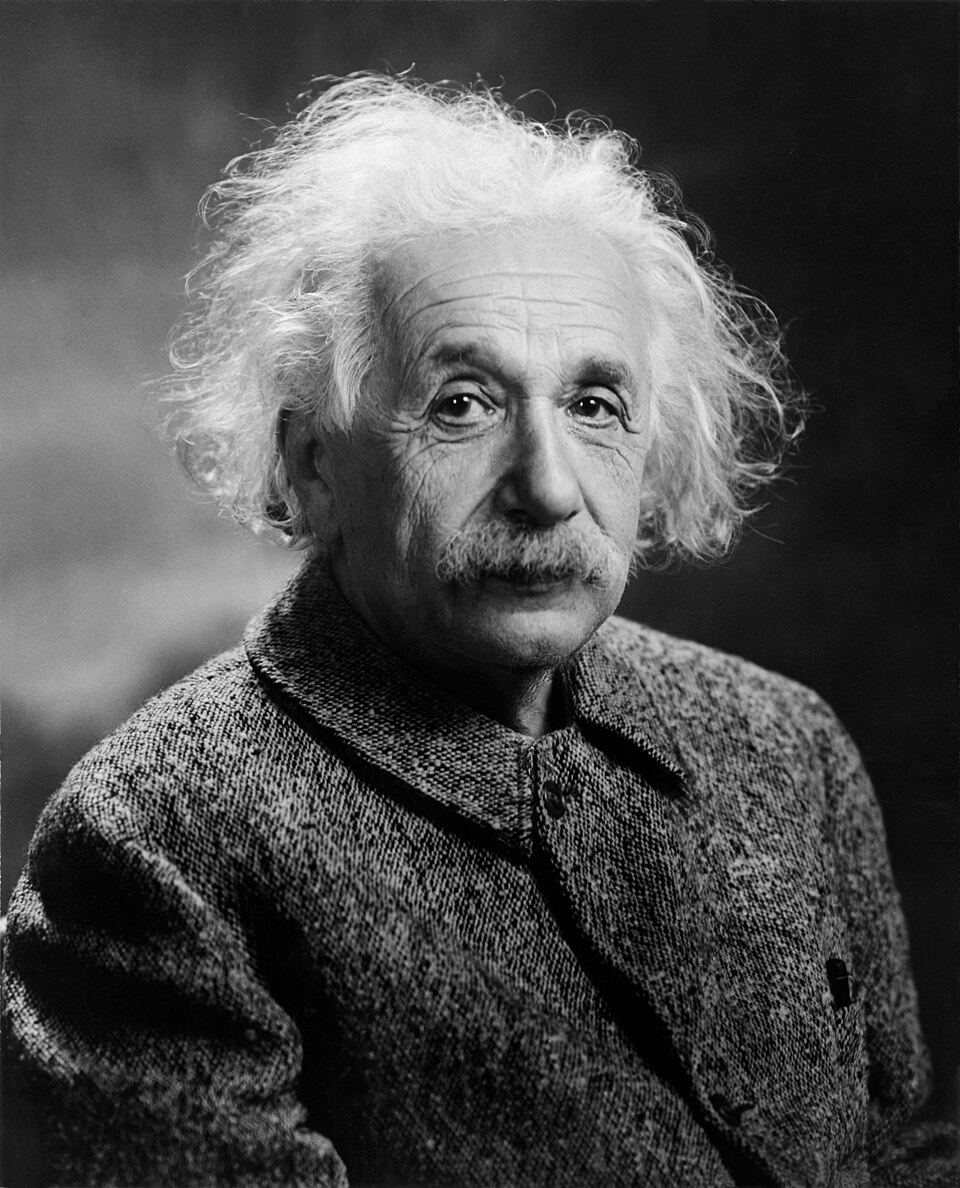
Physics · 1879–1955
Albert Einstein
Die überraschende Tatsache
He won the Nobel Prize, but not for relativity. The committee gave it to him for explaining how light knocks electrons out of metal.
Albert Einstein was born in Ulm, in southern Germany, in 1879, and grew up in Munich, where his father and uncle ran a small electrical business. He was a late talker and an unremarkable student by most accounts, but a compass his father showed him at five stayed with him all his life: something invisible was steering the needle, and he wanted to know what. When the family business failed and moved to Italy, the sixteen-year-old stayed behind at a school he hated, until he gave up, joined his parents, and went back to studying on his own.
After university no one would hire him. He took a job at the patent office in Bern, reviewing designs for electrical machines while he thought about physics in the margins. In 1905, at twenty-six, he published four papers in a single year. One explained the photoelectric effect by treating light as particles. One explained the jitter of pollen grains in water as the push of unseen molecules. One set out special relativity, and one added the line the century would keep quoting: energy equals mass times the speed of light squared.
He spent the next ten years pushing the idea further, working through problem after problem until, in 1915, he produced general relativity: gravity was not a pull through space but the shape of space itself. In 1919 a British expedition photographed a solar eclipse and found that starlight really did bend around the Sun, exactly as he had said. The newspapers made him famous overnight, a wild-haired professor who had redone the universe with a pencil. The attention never really stopped for the rest of his life.
The Nobel committee took its time and played it safe: when the 1921 prize finally came to him, it was for the photoelectric effect, not relativity. By then Germany was turning on him. In 1933, the year Hitler took power, Einstein was lecturing abroad, and he simply did not go back. He settled at Princeton, in New Jersey, and spent his last two decades chasing a single theory that would unify all the forces of nature. It never came together in his lifetime.
In 1939 he signed a letter warning President Roosevelt that Germany might build an atomic bomb; he played no part in the weapon itself and called the signing the one great mistake of his life. In 1952 Israel offered him its presidency and he declined, saying he lacked the aptitude for dealing with people. He died in Princeton in 1955, still working at his desk. The shape of space he drew in 1915 still steers every satellite that navigates the Earth.
Quellen: Encyclopædia Britannica; Nobel Foundation.
Das Quiz
Albert Einstein won the Nobel Prize in Physics. Most people guess it was for relativity. What was it actually for?
Bis morgen. Drei neue Gesichter kommen jeden Morgen dazu.
Keine Anmeldung, keine Zahlung. Die Gesichter sind frei lesbar. Die Morgen-E-Mail kommt mit dem vollen Produkt.